Category: Accounting

How Proper Accounting Reduces Audit Risks

How Proper Accounting Reduces Audit Risks

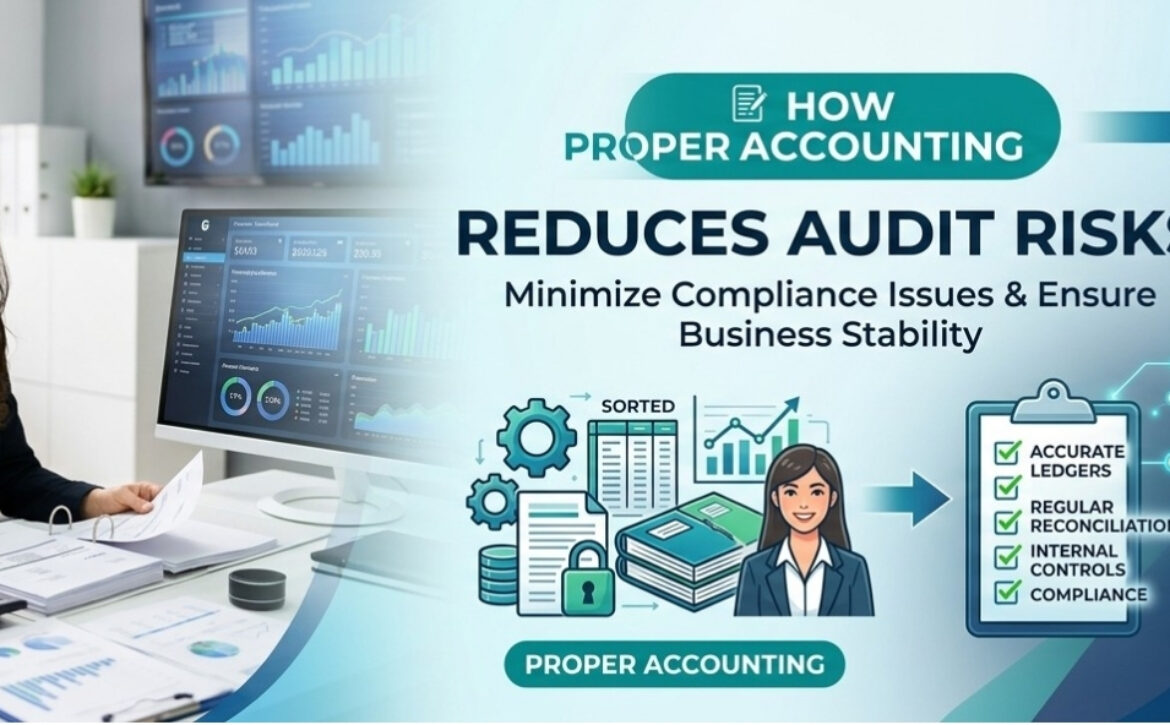
How Proper Accounting Reduces Audit Risks, is a key factor for all modern day businesses. Businesses must always keep track of their financial records. Proper accounting will help to avoid any errors and issues dealing with compliance. Proper accounting will also help to increase a business’s financial transparency and control. Due to the strict regulatory environment and the frequent audits businesses in India must contend with, strong accounting practices are a must for audit risk reduction.

Understanding How Proper Accounting Reduces Audit Risks

All businesses must keep an accurate record of all financial transactions. Through proper accounting, businesses will have a clear, organized way to store and access their complete financial information. When a business has clear records will allow an auditor to verify the information associated with the company. When there are clear records, it will help to eliminate discrepancies and confusion. As a result, the audit process will go quicker and smoother.

Financial accuracy and how proper accounting reduces audit risk

How Proper Accounting Reduces Audit Risks ensures that businesses will consistently have accurate financial information. If there are any errors in the accounting records of a business, it will raise concerns for auditors. If there are accurate accounting records, there will be no need for the auditors to review the company’s financial records for more detail than required because the auditor is getting accurate information that supports the company’s financial accuracy. Through proper accounting, any inconsistencies will be found early in the accounting process.

Also, through proper accounting, the company will produce accurate and reliable financial reports. As a result, the company will be able to significantly reduce its audit risk.

Compliance, and how proper accounting reduces audit risk

How Proper Accounting Reduces Audit Risks, helps businesses comply with federal and/or state and local regulations. Businesses must comply with IRS regulations and the financial reporting rules dictated by the GAAP. Through proper accounting, the company will ensure that tax filings and financial reports are accurate.

Keeping accurate records makes it easier for the business to verify compliance and lessen the potential of being penalized. Because of this, a company is able to keep its reputation in good standing with governing bodies.

The Use of Documentation and How Proper Accounting Reduces Auditing Risks

The ways that proper accounting can help to reduce auditing risk depend upon proper documentation. Businesses need to maintain their invoices, receipts, and accurate financial statements; therefore, having organized records will continue to support audit readiness.

Auditors require clear documentation to perform their work; therefore, having properly maintained records will provide them with the evidence needed to perform an audit with confidence.

Internally Maintaining Controls and How Proper Accounting Reduces Auditing Risk

The reduction of auditing risks through proper accounting is enhanced through strong internal controls. Businesses should have an appropriate system of checks and balances in their financial processes so that their internal control system effectively eliminates errors and fraud.

Regular monitoring of your business’s compliance with procedures improves and enhances the level of accountability among the departments of the business; as a result, a business can effectively reduce its auditing risk.

The Use of Technology and How Proper Accounting Reduces Auditing Risk

Accounting technology has increased the level of risk reduction associated with proper accounting practices. Accounting technologies help businesses automate their financial processes very effectively, and therefore, they reduce their manual errors. Cloud computing provides businesses with real-time access to accurate and up-to-date data. Because of this, the consistency of financial reporting through automation further enhances a business’s overall audit readiness.

Internal Controls and How Proper Accounting Reduces Audit Risks

The role of proper accounting in risk management involves improving the efficiency and effectiveness of businesses’ internal operations. They reduce uncertainties and increase transparency/accountability, creating a more efficient system overall. By identifying issues before they emerge, businesses can take corrective steps to address them early and reduce the likelihood of having significant issues later. As a result, they proactively mitigate risk.

Proper accounting provides several benefits to businesses

It improves financial organization and operational efficiency for a business; hence, the business operates in a much more effective and efficient manner. A business will have an increase in the level of trust with its stakeholders and regulators due to improved accounting practices. Proper accounting assists businesses in making better decisions, hence improving their ability to achieve long-term viability.

How Proper Accounting Can Improve Risk Management through Outsourcing.

Outsourcing the accounting function increases the ability of organizations to effectively reduce audit risk. Professional outsourced services assure accuracy and compliance with laws and regulations. As a result, organizations are able to reduce their workload and, consequently, reduce their audit risk. Professional outsourced services maintain records and ensure compliance with laws and regulations. Additionally, they provide valuable insights into the organization’s financial status.

Outsourcing enhances the accounting function in organizations.

The importance of How Proper Accounting Reduces Audit Risks in an organization’s success cannot be understated. Without accurate records, a business cannot demonstrate compliance with applicable laws and regulations. Therefore, businesses must have strong accounting practices in place.

Businesses that have a strong focus on proper accounting provide the foundation for a successful audit and avoid audit-related challenges. Strong accounting practices will provide businesses with a foundation from which they can grow and maintain stability.

Read More

Role of Bookkeeping in Tax Compliance

Role of Bookkeeping in Tax Compliance

Tax Compliance has an important role for all businesses that do business in today’s highly regulated financial environment. To meet their tax requirements, companies are required by law to keep accurate financial records. Bookkeeping facilitates completing accurate tax filings that happen on time.
In addition, good bookkeeping practices mitigate risks associated with penalties and audits.

In India, businesses must comply with a significant number of strict tax regulations and a set of defined tax reporting requirements. Therefore, solid bookkeeping practices lead to tax compliance and proper financial disclosures.

Understanding the Role of Bookkeeping in Tax Compliance.

The Role of Bookkeeping for Tax Compliance begins with having organized financial data. Bookkeeping utilizes a system of records to organize financial transactions into basic categories, i.e., to record revenue, expenses, and money transaction streams. As a result of having organized records, businesses can quickly determine the amount of taxable income they have generated.

In addition, organized financial records simplify tax calculations and reporting so that businesses can effectively comply with tax regulations. The Role of Bookkeeping in Tax Compliance plays a critical role in providing financial accuracy. Errors in bookkeeping will result in inaccurate tax filings and, therefore, less risk of errors through good bookkeeping.

Accurate financial records contribute to reliable tax reporting and the ability to identify legitimate tax deductions and tax benefits. Therefore, good bookkeeping allows for the legal optimization of tax consequences.

GST and the Role of Bookkeeping in Tax Compliance

The part that bookkeeping plays in ensuring accurate and correct compliance with GST is critical in managing your GST obligations.
All businesses need to accurately report all sales and purchase transactions in their books of account to ensure that they file accurate GST returns.

Accurate recordkeeping will allow a business to reconcile the input tax credit with its GST liabilities on its GST return.
Accurately maintained records will also prevent a business from being subject to mismatches and compliance issues, which could result in penalties and late fees being imposed on the business.

Documentation and the Role of Bookkeeping in Tax Compliance

Bookkeeping, as it relates to tax compliance, also involves keeping all documentation in the business’s records.
The business must keep all invoices, receipts, and financial statements to have their records properly maintained and be audit-ready.

All businesses require appropriate documentation during a tax audit to have proof of what has been reported to the tax authority, and also to create a level of credibility with compliance with the tax authority.

Timely Filing and the Role of Bookkeeping in Tax Compliance

The role of bookkeeping in tax compliance will assist in ensuring that all taxes are submitted to the tax authority on time.
The business must have all returns and payments made on or before the due dates established by the tax authorities to remain compliant. Therefore, regular and accurate recordkeeping is required to avoid last-minute errors.

Consistent bookkeeping practices will provide a business with the necessary current financial information to prepare its tax returns expeditiously and accurately, and result in ongoing compliance.

Technology and the Role of Bookkeeping in Tax Compliance

Automating recordkeeping through accounting software provides faster, easier ways to keep track of all the things you need to report to the IRS, and can save time by automating calculations. Therefore, you will have fewer manual errors. Cloud-based systems give you access to updated financial information anytime you need it and allow you to have accurate tax returns using automated connections. Therefore, technology will help make it easier for you to comply with IRS regulations.

Risk Management and the Role of Bookkeeping in Tax Compliance

Inadequate bookkeeping can defend your company against an audit or impose a fine; therefore, having a good system of record-keeping shows that you are a transparent organization with enough control. Periodic reviews allow for the correction of mistakes or inconsistencies as soon as possible. Your company’s internal controls will promote accuracy in financial records, which will reduce your compliance risk.

Advantages of the Function of Bookkeeping in Tax Compliance

There are many reasons why an effective system of recordkeeping will provide a benefit to your business regarding tax compliance.

Good bookkeeping will provide an effective financial organizational structure and create increased operational efficiency for your business, and will help you to manage your tax obligations promptly. It also allows you to increase your credibility with both the IRS and your stakeholders, thereby enhancing your company’s ability to financially plan for the future and subsequently achieve long-term success.

Outsourcing and the Role of Bookkeeping in Tax Compliance

Outsourcing is a critical element in the area of accounting services, and bookkeeping is central to tax compliance. Outsourcing your bookkeeping creates an environment where you can be assured of accuracy and compliance. Additionally, your business will gain time and resources through this partnership. The accounting professional will continue to update themselves on the new regulations and requirements imposed by the Internal Revenue Service. In addition, they can make meaningful recommendations to help your company improve upon current processes.

As you can see, outsourcing can also add to your overall compliance process.

Your company requires the assistance of a bookkeeper to achieve successful tax compliance. You can only submit accurate records to the IRS through a properly organized bookkeeping system. As such, you must place a high priority on the bookkeeping aspect of your business. Failure to maintain accurate records may subject your company to potential fines and penalties. Ultimately, the foundation for achieving tax compliance lies within your bookkeeping system.

Read More

Importance of Bookkeeping for Small Businesses

Importance of Bookkeeping for Small Businesses

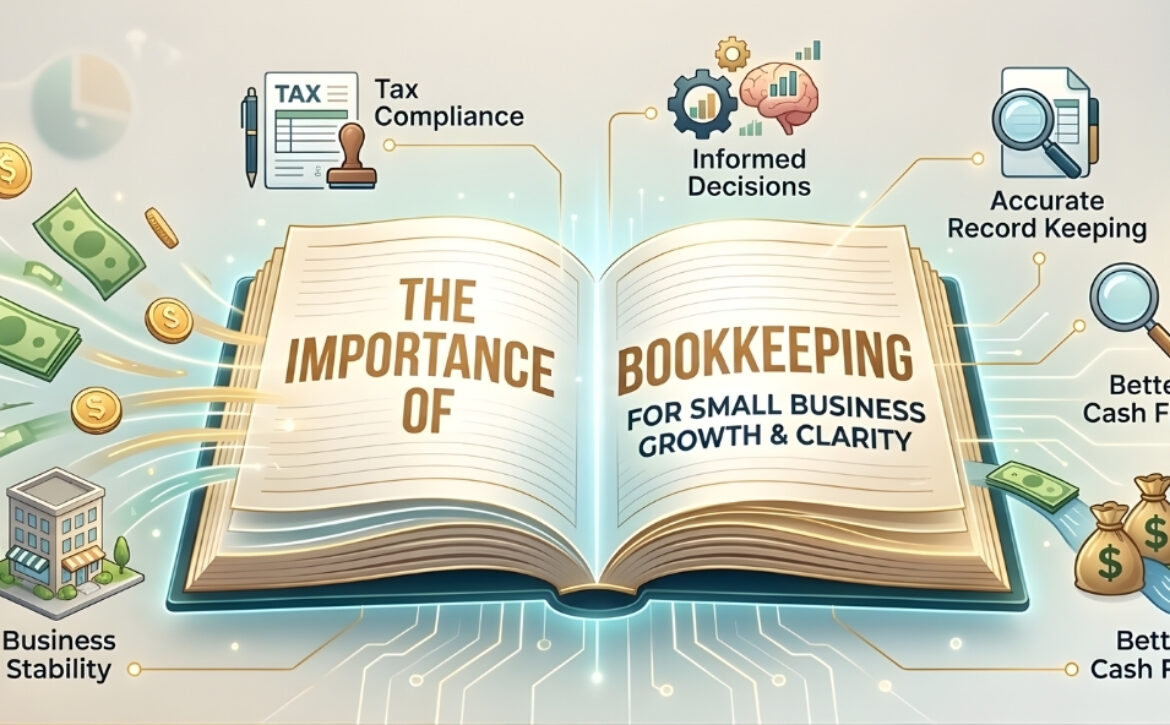
The Importance of Bookkeeping for Small Businesses is more prominent now than ever due to the competitive nature of the modern-day environment. Every firm must be able to accurately document its financial status to remain in business and continue to grow. Through bookkeeping, small business owners obtain control, clarity, and long-term financial stability. Furthermore, through bookkeeping, small business owners can make quick and informed decisions.

Understanding the Importance

Small businesses typically operate under a constrained budget and physical resources. Therefore, having established procedures for bookkeeping is imperative for managing their financial affairs effectively. The first step to understanding bookkeeping’s benefits for small businesses is establishing organized financial records.

Bookkeeping is nothing more than documenting every financial transaction that takes place in an organized manner. By systematically documenting all of a company’s transactions, a small business owner can have a comprehensive view of the company’s revenues and expenditures.

The necessity of maintaining accurate records can provide a greater level of transparency in the company’s finances. Having accurate records can assist in measuring the company’s performance over a time period, thus allowing company owners to run their businesses at their best potential to maximum efficiency.

Financial Accuracy

Bookkeeping is crucial for small businesses as it ensures accurate financial records. Errors in transactions can lead to serious issues, so a consistent bookkeeping system helps minimize discrepancies. Using good records to produce accurate and reliable financial information leads to establishing trends and patterns of cost, thereby increasing the efficiency of the day-to-day operations of the small business.

Cash Flow Management

Cash flow management has been heavily impacted by the way bookkeeping assists small businesses with their overall cash flow management. Small business owners need to monitor their incoming and outgoing cash regularly. As a result, proper bookkeeping helps keep the company in good standing financially.

When cash flow is tracked regularly through bookkeeping, it helps to keep businesses from running out of cash or having delays in making payments to suppliers or employees. Therefore, small businesses are able to maintain financial stability.

Tax Compliance

Bookkeeping plays a critical role in supporting small business owners when preparing their tax returns in a timely and accurate manner. In order for small business owners to accurately prepare their tax returns, they must use properly kept books.

Bookkeeping helps to reduce the possibility of errors when preparing tax returns by providing well-organised records that can be used for reference. Additionally, small businesses will be able to avoid penalties and threats of litigation as long as their bookkeeping records are kept properly. As a result, bookkeeping helps maintain compliance and credibility for small business owners.

Decision-Making

When it comes to making decisions, bookkeeping allows small business owners to make more informed decisions. Small business owners use financial data when developing a business plan and developing a strategy, which requires accurate financial records. Because of this, small business owners can gain valuable insights from their accurate records.

Financial reports can help small business owners identify areas that are profitable and areas that are not working, which will guide them to make more informed pricing management, budgeting, and investment decisions in the future. This will enable small businesses to achieve a greater level of success than they would have without the use of effective small business bookkeeping.

How Technology Is Helping Small Businesses Grow

The growing use of digital tools increases the importance of bookkeeping for small businesses. New accounting software greatly reduces the difficulty of doing bookkeeping tasks. This means that businesses can reduce human error and save time because they won’t be entering data manually.

Cloud-based systems allow for real-time updates to financial data. Automation allows for accurate and quick reporting. This makes financial management easier because it uses technology to help.

Reducing Financial Risk Of Bookkeeping For Small Businesses

The importance of bookkeeping for small businesses is essential in reducing the risk of financial loss. If you do not keep your records properly and accurately, you leave yourself open to potential fraud or mismanagement. So having the proper systems in place will give you the ability to be more accountable and transparent.

By having periodic reviews of your business’s financial status, you can detect errors or irregularities in your business’s financial records sooner rather than later. With the addition of internal controls to your business, you can improve your overall financial security. This, in turn, allows you to better safeguard your assets.

Growth Of Bookkeeping For Small Businesses

The importance of bookkeeping for a small business is necessary to support its long-term growth. By having accurate financial data, businesses have the ability to create an expansion plan. As a result, you will be able to allocate resources in an efficient manner. Investors and lenders will want to see accurate financial statements. When you have proper accounting records, you will increase your chances of being able to obtain funding from investors and lenders.

Outsourcing and The Need for Small Business Bookkeeping Increases With the Utilization Of Professional Assistance. An outsourced provider will decrease the amount of work you have to do while also ensuring that your work is being done correctly. Outsourcing allows you to concentrate on your main functions as a business.

Professional bookkeepers will ensure that your company is complying with all financial regulations and that your company is being properly managed financially. In addition, they will provide insight into how your company can grow, so as to ultimately be more efficient and reliable.

Small businesses rely on bookkeeping to be successful. Bookkeeping provides financial accuracy, compliance, and a way to plan. As a result, all companies should make bookkeeping a priority. Companies have a greater chance for stability and growth when they keep accurate financial records. Adequate bookkeeping lays the groundwork for a successful business long-term.

Read More

Future of Account Bookkeeping in India

Future of Account Bookkeeping in India

In the prospect of Account Bookkeeping in India is an example of the evolution of methods for managing finances in businesses. Companies are transforming the way they manage, record, and organize their accounting information due to rapidly moving advances in technology.

As such, organizations are turning to modern bookkeeping systems to achieve enhanced productivity and accuracy in performing their bookkeeping duties. Businesses in India are increasingly reliant on using digital technology to manage their financial affairs.

As a result, bookkeeping is quickly changing from paper-based processes to automated systems for carrying out financial transactions.

Technology and The Future Of Account Bookkeeping In India

The future of Account Bookkeeping In India has a significant reliance on the use of technology. Businesses are implementing cloud-based accounting programs to provide easy access to and better organization of their accounting data.

As a result, businesses can now monitor their transactions and maintain their accounting records on a real-time basis. Automation also allows for a reduction in repetitive tasks and decreases in human errors associated with performing accounting functions. Digital platforms also enhance the collaboration of accountants and business owners.

Therefore, technological advances are improving the accuracy and productivity of financial management.

Automation Trends In The Future Of Account Bookkeeping In India

The Future of Account Bookkeeping In India will continue to experience increasing levels of automation across accounting functions. Currently, many businesses are employing artificial intelligence to classify their financial transactions automatically.

Therefore, accountants are being allowed to concentrate an increased amount of their time on providing financial analysis and conducting strategic business planning.

In addition, automated systems can provide instant generation of a business’s financial reports. This capability will provide greater transparency for businesses as well as improve the overall ability to monitor business performance. Consequently, automation will also lead to an increase in the productivity of the accounting profession.

Future Account Bookkeeping (India) Compliance & Regulation

The future of bookkeeping in India will require rigorous compliance with financial regulations. There is a clear demand for accurate reporting and transparency in accounting for businesses, which means they must keep organized and current financial records.

Digital bookkeeping simplifies the complexities of managing compliance. Digital bookkeeping allows businesses to track tax obligations and deadlines, allowing them to minimize the risk of penalties or audits.

Cloud Accounting Future of Bookkeeping (India)

Future bookkeeping in India will be more cloud-based than ever before. A cloud-based financial system provides businesses with access to their financial data securely, from anywhere. This has greatly enhanced their ability to be flexible and to operate efficiently.

Real-time updates create opportunities for accurate financial tracking and monitoring. Cloud-based solutions also offer secure data backups. This provides businesses with better protection of their financial record against data loss or cyber-attacks.

Future of Accountants in Bookkeeping (India)

The role of accountants and their focus on bookkeeping in India will change dramatically going forward. Accountants will place greater emphasis on advisory services and financial analysis; therefore, accountants will play a critical role in the overall strategic planning of the business.

Accountants interpret financial data to assist businesses in making decisions. Their expertise helps businesses to increase profitability and mitigate risk. As a result, accountants will continue to be integral partners in the growth of the business.

Account Bookkeeping in India: Future for Small Businesses

The future of bookkeeping in India has the potential to significantly assist small and medium-sized enterprises. Digital bookkeeping services help growing companies with their ability to manage their finances; therefore, this allows SMEs to decrease their administrative and operating cost burden.

Quality, inexpensive accounting software includes many valuable features for day-to-day bookkeeping. As a result, this enables entrepreneurs to gain greater insight into and control of their respective finances.

Furthermore, through enhanced financial discipline and better financial planning, small businesses can improve their financial health.

Data Protection in the Future of Bookkeeping in India

The future of bookkeeping in India focuses on data protection. Many businesses keep their financial data in digital systems that contain sensitive information.

As such, businesses must put proper cybersecurity measures into place. Financial data can be protected by encrypted data and secure backup procedures. Additionally, regular system monitoring will identify any possible threats to that data early on.

This will allow businesses to continue operating while maintaining their credibility.

Integration with Other Business Systems

The future of bookkeeping in India will bring about the integration of accounting (bookkeeping) systems with other operational business systems. Most of the accounting (bookkeeping), inventory, payroll, and sales systems being used today are linked.

Thus, this integration will ensure that financial records are always consistent. By integrating these systems, businesses will be able to eliminate double data entry. By integrating systems together, businesses will be able to produce complete financial information far more quickly, which will allow for better and more efficient decision-making.

Skill Development For The Future Of Account Bookkeeping In India:

Professional development via continuous skill development is essential to accounting’s future. Accountants must utilize digital tools and utilize increasingly sophisticated technology tools. Thus, there are numerous training programs available to assist professionals in developing skills.

In response to the growth of technology, many educational institutions now offer technology-specific accounting courses to help professional accountants prepare for the financial markets of the future. As a result, today’s workforce is better equipped to meet the changing demands of bookkeeping processes.

Future Opportunities for the Future Of Account Bookkeeping In India:

The future of accounting will have numerous opportunities for many accountants. Digital transformation will fuel the growing demand for bookkeeping professionals who possess the skills necessary to operate in a rapidly changing world. Thus, accounting professionals with experience and knowledge of technology will have competitive job advantages.

Accounting professionals will additionally have many opportunities available to be consultants or advisors in business financial planning. This growing demand will create new accounting positions, as bookkeeping continues to evolve into a more strategic and innovative profession.

The future of bookkeeping in India will emphasize the movement from traditional bookkeeping to digital and automated financial management. Bookkeepers’ use of technology, compliance, and their professional knowledge will be the driving force behind this transformation. Therefore, in order for businesses to succeed, they will need to learn how to implement modern-day bookkeeping processes.

Businesses that are willing to innovate will create a more efficient and transparent financial management system, and ultimately, the future of bookkeeping in India will support long-term, sustainable growth of businesses.

Read More

Top BI Report Developer in Dubai, UAE

Top BI Report Developer in Dubai, UAE

In the digital economy, one of the most valuable assets a company can have is access to data. More and more companies in Dubai are realizing that data analytics and business intelligence (BI) can add value to their strategic decision-making processes. At Slick & Sharp, we are the top BI report developer in Dubai, UAE, and we enable companies to leverage their data analytics for business growth, operational efficiency, and intelligent decision making.

Why BI Report Development Matters?

Business intelligence is more than simply dashboards—it is an exploration of raw data converted into a business story. As the top BI report developer in Dubai, UAE, we help businesses take full advantage of BI applications such as Power BI, Tableau, and QlikView. BI reports build on business ideas—from sales trends to optimal inventory sales—to help guide the business.

Key Advantages of Working with a Top BI Report Developer

  1. Customized Dashboards & Reports: Every business has specific KPIs. A top BI report developer in Dubai, UAE, builds reports customized to your operational objectives, industry standards, and user backgrounds.
  2. Real-Time Data Integration: Our developers build dashboards that pull real-time data from different sources, so your leadership team has timely insights right when they need them.
  3. Actionable Visualizations: Raw data is often intimidating. We take raw outputs of data and turn them into easy-to-understand charts, heat maps, and scorecards that make for sure decision-making.
  4. Predictive Analytics: With the right combination of advanced analytics, forecasting capabilities, and machine learning capabilities, a top BI report developer in Dubai, UAE, allows companies to predict trends and take advantage of opportunities.
  5. Data Governance & Accuracy: Clean data is the bedrock for any reliable reporting. Our BI report development processes take care when validating and cleaning valuable datasets to ensure they are error-free.

Industries We Serve

As a top BI report developer in Dubai, UAE, Slick & Sharp works with companies from many industries, including:

  • Healthcare and Diagnostics
  • Financial Services and Tax Advisory
  • Legal and Corporate Compliance
  • E-commerce and Retail
  • Real Estate and Construction

We can customize our BI report solution to their regulations, performance indicators, and reporting standards.

Why Choose Slick & Sharp?

Our experience, unique blend of skills, and deep understanding of the fast-changing digital landscape of Dubai is what make us the leading provider of BI report development in Dubai, UAE. We have a team of data engineers, data analysts, and visual designers who come together to provide BI tools that make a difference.

Conclusion

Selecting the top BI report development provider in Dubai is a strategic choice for your business growth. At Slick & Sharp, we help businesses turn data into insights and make informed decisions.
Turn your data into strategy. Slick & Sharp, the leading BI developer in Dubai, is ready to help you enhance your business intelligence.
Read More

Account Bookkeeping

Account Bookkeeping: The Key to Financial Success for Slick & Sharp

Introduction

To be successful in the long term, records will have to be accurate in this fast-paced business world. Slick & Sharp understands account bookkeeping and the fact that it is a key pillar of financial stability, transparency, and strategic growth. Be it a small business or a big corporation, account bookkeeping is a major criterion for efficient financial management.

What is Account Bookkeeping?

Account bookkeeping is generally considered a valued service by which financial transactions in any business are recorded or tracked carefully under their heads. The transfer goes for precise details of income, expenses, taxes, or any general financial activities. At Slick & Sharp, we believe that proper bookkeeping will help a company in financial decision making, regulatory compliance, and operating transparency.

Why Account Bookkeeping is Essential for Slick & Sharp

  1. Accuracy and Organization: Keeping systematic financial records provides accuracy with your reporting from an accounting perspective and protects against accuracy errors. With accurate bookkeeping arrangements Slick & Sharp can organize finances around their business without having to worry about tracking errors with the business. 
  2. Improved Decision-Making: When owners keep their records up to date they are able to make informed decisions about their investments, budgets, and legalized cash flow forecasts.
  3. Tax compliance and Protection: Good bookkeeping provides proper caption accounting systems that delineated with pointers of how the tax code is currently articulating to you which prevent unwanted penalties and audits on the business.
  4. Growth and Business Usage For Businesses: Bookkeeping serves a purpose to show business which of their financial trend and satisfactorily confirm the future growth of the business. At Slick & Sharp we can use bookkeeping forms to improve the social and environmental space.

Best Practices for Effective Account Bookkeeping

1. Choose a Reliable Accounting System:

Buying a good accounting system, since everyone has an accounting system already, like Quickbooks or Zoho Books, assist with sound accounting knowledge and bettering sustainable accounting practices. Serious accounting software should automate bookkeeping and help with errors or failures in the accounting process.

2. Categorizing Financial Transactions:

Categorize all of your income and expense transactions so you can have accurate reporting to measure your financial conditions of health. Categorizing income and/or expense transactions increases the company’s ability to file taxes properly and reduces unnecessary expenses.

3. Audit and Reconcile all Financial Transactions:

You should be fastidious to detect and looking at the potential failure here in audits, where everyone is going to be taken through a due process of time. At the end of the day, auditing and reconciling your transactions can be a fantastic method to ensure that the process is accurate, and that is called fiscal accountability.

4. Maintain Digital Records and Data Backup:

In this digital era, electronic storage of financial records secures the life of a record and its accessibility. At Slick & Sharp, we advocate for backing up your financial data to avoid losing chances in case of system failure.

5. Engaging in Bookkeeping Services:

For businesses that desire to streamline their financial management processes, outsourcing accounts bookkeeping to professionals ensures accuracy and compliance.

Conclusion

Bookkeeping is an important part of throughgoing finance, including the success of a business. At Slick & Sharp, we lay focus on keeping updated and accurate financial records for stability, compliance, and growth. The adoption of best practices in bookkeeping equips businesses to make informed decisions for the maintenance of their financial health.

Invest in dependable account bookkeeping now and see your business soar higher!

Read More

Top Accounting & Bookkeeping Services

Top Accounting & Bookkeeping Services


Proper financial management is the backbone of any successful business. Top accounting & bookkeeping services bestow transparency upon financial matters, while building a complete framework for legal compliance and decision-making for startups and enterprises. When opted for by businesses, the growth focus remains with the business, coupled with the professionals taking care of these numbers efficiently.

Why Accounting & Bookkeeping Services Matter

Financial management is required for ensuring the profitability of the business and its continued existence. In brief, here’s why these services are an absolute necessity:

Accurate Financial Tracking – To enable businesses to track their cash flows and expenses properly.
Compliance with laws – To establish standards for tax and statutory compliance, thereby avoiding penalties.
Efficient Tax Planning – Accountants and tax consultants must assist in reducing the tax burden and claiming maximum deductions.
Improved Decision-Making – Well-maintained books give insight into strategic business planning.
Time & Cost Savings – Keep accounting errors away and save valuable resources through outsourcing.

Top Accounting & Bookkeeping Services Offered

Generally speaking, the top accounting & bookkeeping Services firms cover a wider range of services to address the needs of different businesses. Here are some prominent services:

  1. Bookkeeping & Financial Recording: Meticulous record-keeping requires balanced financial assets, and bookkeeping systems guarantee that all daily business activities, payments, and invoices recorded effectively, making year-end accounting stress-free.
  2. Payroll Management: The timely payment of wages and the deduction of taxes influence employee satisfaction. Payroll services handle salary payments, tax filings, and compliance with labor laws.
  3. Tax Preparation & Filing: Tax engagements, from corporate tax planning to VAT registration, help businesses comply with regulations and file returns on time, avoiding fines.
  4. Audit & Assurance Services: Regular audits boost the confidence of businesses around the internal processes, assuring employees about the financial health of the organization. Audit services add value by assuring a true and fair view of financial statements in line with statutory requirements.
  5. Financial Advisory & Forecasting: In times of extreme economic uncertainty, sound financial strategies become critical. Accounting professionals equip clients with critical financial advice concerning budgeting, forecasting, investment planning, and cost control.
  6. Accounting Software Integration: Today’s businesses use accounting software such as QuickBooks, Xero, or Zoho Books to track finances effectively. Advisors help in installing and integrating these applications for smooth functioning.

How to Choose the Best Accounting & Bookkeeping Services

Choosing an ideal accounting firm is very important. The following should be considered before the decision:

  • Industry Experience – Go for a firm having specializes in your line of business.
  • Technology Integration – Opt for experts working with sophisticated accounting tools.
  • Transparent Pricing – Be assured of competitive and open pricing schemes.
  • Client Reviews & Reputation – Check reviews to confirm credibility.

Conclusion

Top Accounting & Bookkeeping Services are critical to business success and financial stability. With help from leading accounting firms, companies can stay compliant, minimize taxes, and make smart decisions for sustained success.

Read More