Category: Uncategorized

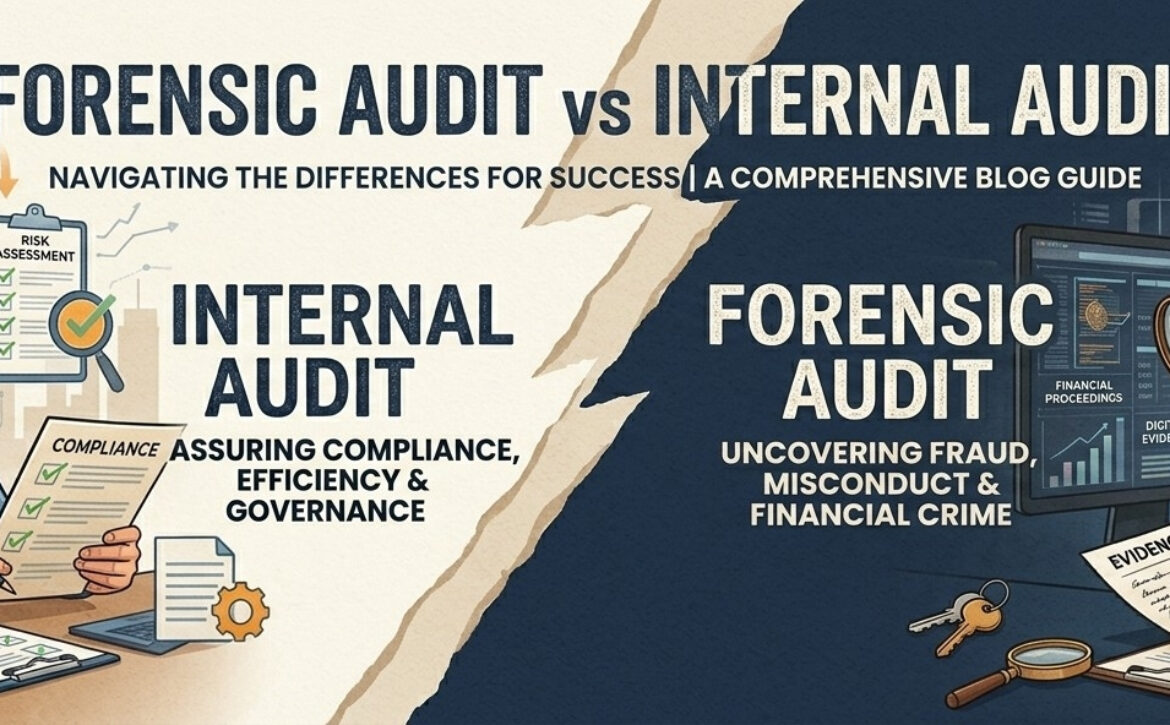
Forensic Audit vs Internal Audit

Forensic Audit vs Internal Audit: When to Use Each

In today’s competitive world, understanding the differences and purposes of both a forensic audit and an internal audit is very important! Businesses are required to protect their assets and ensure compliance at all times while doing business today. Understanding Forensic Audit vs Internal Audit will help improve financial controls, as well as give you better control over financial risks and make more effective decisions.

Companies in India face an increasing risk of non-compliance with laws and regulations, and the risk of fraud; therefore, every business needs to select and implement the right audit methodology. Understanding the important differences between Forensic Audit and Internal Audit. To better understand how you should use a forensic audit vs. an internal audit, you first must understand the two definitions.

Forensic Audit: An audit performed to investigate issues of financial fraud or misconduct. The primary emphasis is on collecting evidence and providing support for use in legal proceedings.

Internal Audit: An audit performed to assess the performance of business processes and internal controls for purposes of compliance with applicable laws, regulations, and policies; and to also support the adoption of “best business practices”, resulting in improved operational efficiency within the organization. Both of these have different purposes, so it is crucial to understand the differences.

Forensic Audit vs Internal Audit: When to Use Each

It provides a clear and easy-to-understand description of the major differences between these two types of audits. The primary purpose of a Forensic Audit is to identify potential fraud and investigate the occurrence of fraud. In comparison, the primary purpose of an Internal Audit is to prevent fraud and provide fraud control measures.

A Forensic Audit will typically follow a suspicious event, while an Internal Audit is conducted on an ongoing basis, as part of a regular process. Therefore, the timing and purpose of these audits are fundamentally different.

Purpose of Forensic Audit vs Internal Audit

The purpose of a forensic audit is to detect fraud and gather the necessary evidence for legal proceedings. In addition, a forensic audit helps with resolving litigation and dispute matters as well.

The purpose of an internal audit is to review and improve processes, reduce the likelihood of risk, and help ensure an organisation is compliant with policies and regulations. Therefore, there is a definitive reason for a business to use either an audit, depending on the business’s objective.

When to Use Forensics Audit vs Internal Audit

The difference between a forensic audit and an internal audit will be more apparent if you consider specific instances where you might use one versus the other. Utilise forensic audits when you suspect fraud or wrongdoing. Forensic audits will help identify financial irregularities and/or the parties responsible for the irregularities.

Utilise internal audits as part of ongoing monitoring and to assess the level of risk your organisation faces. Internal audits will assist in increasing operational efficiency, as well as improving the internal controls of your organisation. This will then allow for the ongoing growth and development of the organisation.

Benefits of Forensic Audit vs Internal Audit

Forensic audit and internal audit provide significant benefits to each organisation that utilises these two forms of audits. The primary benefit of utilizing forensic audits is to recover lost funds and/or prevent future fraud from occurring. In addition, the evidence obtained during a forensic audit also aids in building a successful legal case.

The primary benefit of an internal audit is to improve operational efficiency as well as to ensure organisational compliance. Internal audits will also assist in identifying and addressing potential risks before they develop. As a result, the organisation will maintain a stable and controlled environment.

Technology’s Role

The use of technology for forensic and internal audits has increased greatly. Auditors today can analyze financial data very quickly using digital tools. That allows them to detect anomalous trends and patterns within the financial data much more efficiently than before. In addition to improving the speed and accuracy of forensic audits, data analytics is also enhancing the ability of auditors to detect fraud. The use of automation in the reporting and monitoring process of audits will also increase audit effectiveness through technology.

Challenges of Forensic and Internal Audit

There can also be specific challenges to conducting forensic and internal audits. Forensic audits require specialized skills and detailed investigative procedures, which may make forensic audits expensive and time-consuming in comparison to internal audits. Internal auditors will likely face resource and expertise limitations, and as a result, they will need to continuously monitor and update their audits. Businesses will need to carefully plan their audit schedules to ensure they are able to manage their audit resources effectively.

The Importance

Forensic and internal audits are critical to the success of any business because each audit serves as a way for a business to balance its prevention strategies with its investigative strategies. Combining both types of audits provides a holistic approach to risk management for any business. Internal audits will help mitigate risks to the business proactively, and forensic audits will help address specific incidents of misconduct reactively. Ultimately, the business will achieve total control over its finances through the use of forensic and internal audits.

How Technology Will Shape the Future

The use of technology is improving how forensic auditors find fraud and conduct investigations, leading to faster and more accurate audit results. The regulatory environment becomes increasingly stringent, and as a result, the accounting profession must develop modern audit techniques. Audit functions will become more strategic in the future due to all of these factors.

By understanding when to use each type of audit, businesses can gain greater clarity in their financial management processes. Each type of audit serves an entirely different function in relation to a company’s financial management practices. Companies need to select the best audit methods for their requirements to ensure that their internal controls are functioning properly.

By utilising both forensic and internal audits in tandem, organisations can enhance their level of control over their activities and thereby increase their level of transparency. Combining these audits will help to ensure the long-term viability of an organisation.

Read More

The Importance of Bookkeeping for Small Businesses in India

The Importance of Bookkeeping for Small Businesses in India

Bookkeeping is increasingly important to small businesses in India, particularly in the current competitive marketplace. Small businesses must keep track of their financials to continue to operate and grow. Proper bookkeeping provides these businesses with clarity, control over their business, and enables them to make informed decisions. It is also important for compliance purposes and ensuring sustainability over a long time horizon.

The financial landscape for companies in India is ever-evolving. Thus, maintaining accurate and up-to-date financial records is paramount for small businesses to successfully operate.

Understanding the Importance of Bookkeeping for Small Businesses in India

The Importance of Bookkeeping for Small Businesses in India starts with the tracking of financial records as they occur on a daily basis. This allows businesses to develop a good understanding of their overall financial health.

The accuracy of financial records will help business owners make good business decisions. In addition, the accuracy of financial records will increase the accuracy of financial budget preparation and financial planning processes. As a result, the business can operate with greater confidence and control.

Financial Accuracy and the Importance of Bookkeeping for Small Businesses in India

The Importance of Bookkeeping for Small Businesses in India is that it ensures accuracy in the company’s financial records. When a company has incomplete or inaccurate records, the business owner will not have adequate information on which to base his or her business decisions. Errors in record-keeping can result in poor business decisions, which will lead to business losses. Keeping accurate records with consistency from one period to the next reduces the possibility of mistakes and discrepancies.

With accurate financial records, a business can prepare reliable, timely financial reports and have accurate financial records, will be able to assist identifying historical trends in revenue and expenses. Additionally, accurate financial records allow businesses to improve operational efficiencies.

Tax Compliance & Bookkeeping’s Importance to Small Businesses in India

The importance of bookkeeping for small businesses in India is its contribution to tax compliance. Businesses are required to submit the correct GST and income tax returns for both GST and income tax purposes. Therefore, by maintaining accurate bookkeeping, businesses will be able to accurately calculate their taxes owed.

Having organized records will streamline a business’s filing of returns and the documentation required to support those returns. Organized records will also minimize the risk of penalties and legal issues so that companies can continue to remain compliant with the authorities.

Importance of Bookkeeping and Cash Flow Management

The importance of bookkeeping for small businesses in India supports cash flow management. Businesses must routinely monitor the inflow and outflow of cash from their business to maintain liquidity and stability. Therefore, maintaining accurate bookkeeping records will help a business to avoid financial shortages and to make timely payments to suppliers and employees. As a result, the business will not only continue to maintain its cash flow but also maintain financial discipline.

Importance of Bookkeeping and Decision-Making

The importance of bookkeeping for small businesses in India enhances business’ decision-making capability. Business owners make strategic decisions based on their financial data. Therefore, by keeping and maintaining accurate records, a small business will have access to valuable information to consider when making important decisions.

Using financial reports, a business can identify which areas are producing a profit and which areas are costing them money, in addition to assisting them in making pricing decisions and investment decisions. Consequently, the businesses will be able to achieve greater growth results.

Role of Technology in the Importance of Bookkeeping

The growing relevance of Bookkeeping for small businesses in India is established through the increasing automation of bookkeeping processes. Many businesses now use technology that makes the use and management of financial transactions easier, with minimal manual input required. As a result, this technology-based approach to bookkeeping reduces the number of errors made in bookkeeping and increases the efficiency of completing bookkeeping activities.

Cloud computing has provided new ways for businesses to track their financial performance. Innovations in finance software continue to drive increased accuracy and speed in reporting. Therefore, technology continues to improve and enhance overall financial management.

Risk Reduction and the Importance of Bookkeeping

The Importance of Bookkeeping for Small Businesses in India also helps lower the risk of financial failure. The risks associated with record-keeping include opportunities for fraud and poor management of the company’s funds. By having accurate record-keeping systems in place, the Company can achieve a higher level of transparency and accountability.

Reviewing records regularly will assist in identifying and minimising anomalies early. Strengthening internal controls allows a Company to better safeguard its assets.

Business Growth and the Importance of Bookkeeping

The Importance of Bookkeeping for Small Businesses in India ultimately supports the long-term growth of the Company. Businesses with accurate and consistent financial records are in a better position to have a well-defined strategy to support their expansion. As a result, companies can optimise their use of available resources.

Accurate financial statements are essential for businesses attempting to obtain financing from lenders or equity sources. Good and sound record-keeping enables a Company to improve its credibility and enhance its ability to obtain financing. As a result, by having good financial records, a Company is better positioned to expand its operations successfully.

Outsourcing Bookkeeping and How it Benefits Indian Small Business Owners

For small businesses in India, Outsourced Bookkeeping Service Providers offer them Professional Assistance for Simplifying Operations (i.e., reducing the Workload). As a Result, The Business Can Put Its Focus Back on Its Core Business. Outsourced Bookkeeping Professional Services Will Also Provide Businesses with the necessary financial compliance experience and Accuracy with Rules and regulations, and All The Information You Need to Understand How to Improve Your Operations Financially. They Will Increase Their Reliability By Providing Greater Operational Efficiency Through Their Professional Expertise.

As a Business Owner, You Should Not Underestimate the Value of Maintaining Accurate Bookkeeping Records, Especially In Today’s Business Environment, Since Accurately maintaining Your Books Is Essential for Ensuring Compliance, Control Over Your Finances as Well as Developing Great Business Plans for Future Growth. All Businesses Should be Dedicating Time and Resources to establishing strong bookkeeping records.

When Businesses Do a Good Job of Maintaining Accurate Bookkeeping Records, They Have a Much Greater Ability to Achieve Long-Term Business Stability And Success for the Future. A Business’s Bookkeeping Records Create the Foundation for Business Growth.

Read More

Tax & Compliance Services in India

Tax & Compliance Services in India

Tax and Compliance Services play an important role in everyday business success. Companies need to abide by various legal and regulatory requirements while at the same time achieving maximum financial benefit through their work. Because of this tax, compliance services provide professional assistance to guide companies through their day-to-day operations without instances of non-compliance.

Avoiding notices or fines from the tax authorities allows a company to continue its operations.

Tax services and compliance services are continually evolving due to changing tax laws, regulations, and reporting requirements; companies must remain informed and take a proactive approach in providing compliance and performing compliance practices.

Why Tax & Compliance Services are Important to a Company

Tax & Compliance Services allow companies to maintain financial discipline and transparency. Companies need to be able to file an accurate tax return, keep accurate tax records, and maintain compliance with their respective regulatory authority in order to show their credibility to both investors and regulators.

Filing accurate tax returns on a timely basis minimizes the exposure to both penalties and audits. Accurate reporting of a company’s financial activity allows it to improve its long-term financial planning and decision-making processes and have long-term sustainable operations.

Types of Tax Services/Compliance Services

Typical tax services/compliance services would encompass many different aspects of a company’s financial activities, such as:

– Income tax
– UK Corporation Tax (UK Corporate Tax Planning/Corporation Tax)
– Goods and Service Tax (GST – GST compliance)/Tax compliance

Consequently, companies that use a tax service firm or a compliance service firm receive help with meeting their obligations to the various authorities.

In addition to providing support in completing regulatory filings, tax compliance professionals also assist their clients in ensuring compliance with relevant regulatory guidelines of government agencies/authorities, as well as industry standards. Therefore, all companies continue to perform their day-to-day activities without disruptions or loss of compliance with various regulatory authorities.

GST Compliance in Tax & Compliance Services in India

Tax and Compliance Services in India include the management of Goods and Services Tax (GST). Under GST, companies are responsible for filing GST returns accurately and on time. Therefore, if your company does not have proper GST compliance, you could face penalties or disruptions in business operations. Tax and compliance professionals can assist you in reconciling your input tax credits and ensure the invoices are in order. They can also help with ensuring that there is the correct classification for all transactions.
By providing this level of assistance, we help you maintain compliance with your GST obligations and to ensure the accuracy of your financial statements.

Corporate Tax Planning & Compliance

Tax & Compliance Services in India can also assist with effective corporate tax planning to enable your company to pay the least amount of taxes while complying with all applicable laws. Through strategic planning, companies can maximize the profitability of their business operations.

Tax professionals analyze your accounting records to develop strategies to minimize your company’s tax liability. They will also verify that you comply with current tax legislation. Consequently, by utilizing these professionals’ advice, your company will reduce the potential for tax audits and improve its financial performance of your company.

Technology’s Impact on Tax & Compliance Services in India

Tax & Compliance Services in India are rapidly adopting new technologies such as digital tools and automated compliance processes. Tax software applications make it easier for businesses to complete their tax calculations and meet their reporting requirements. Therefore, by implementing technology, businesses can streamline their operations and reduce the chance of human error.

Through cloud computing, companies have access to real-time data about the financial position of their business. By automating their tax compliance processes, companies can file taxes in a timely manner and have a sufficient level of supporting documentation for their tax returns. As a result, technology is enabling businesses to better manage their compliance activities.

Outsourcing Tax & Compliance Services in India: Benefits

When Tax and Compliance Services are outsourced to professionals in India, they become more effective. Outsourcing Tax and Compliance Services can help reduce the internal workload and costs associated with a company’s operations, allowing it to devote more time to its core operations.

The professional firms provide expert knowledge and skills related to Tax and Compliance Services. They stay current with changes to the regulatory environment and compliance requirements, improving the accuracy and efficiency of compliance for businesses.

Challenges Associated with Tax & Compliance Services in India

Companies face multiple challenges when providing Tax and Compliance Services in India. Due to the rapid pace of change in regulations, businesses experience challenges in complying due to the complexity created by the frequency of regulatory updates.

Due to the reliance on manual systems, companies have a higher likelihood of making mistakes or experiencing delays. Furthermore, due to a lack of knowledge or expertise, a company may be at risk of non-compliance.
As a result, professional guidance is critical.

Risk Management Through Outsourcing Tax and Compliance Services in India

Tax and Compliance Services support a company’s ability to manage risk by addressing its financial or regulatory risks. By ensuring adequate documentation is available, companies reduce the likelihood of being at audit risk. As a result, companies are able to maintain transparency in their financial reporting.

Regular reviews for compliance will identify issues before they become problematic. Taking corrective action eliminates the possibility of penalties or legal complications. As a result, businesses can operate with confidence.

Tax and compliance services in India are expected to evolve, incorporating technology as well as new legislative requirements. Automated systems for tax compliance and artificial intelligence will improve the compliance process for many businesses by automating some of the work.

As digital reporting systems enhance transparency and efficiency, regulatory frameworks will become more comprehensive. This means that compliance will become more integrated into business strategy.

Future Trends in Tax & Compliance Services in India

Tax and compliance services will be a key driver of sustainable business growth in India, helping to ensure that companies comply with their legal obligations, accurately report their financial performance, and effectively manage risk all of which are critical to success. As a result, companies need to ensure that they prioritize compliance as part of their business operations.

By utilizing professional services to meet their compliance obligations, organizations have the opportunity to increase their overall level of operational efficiency and improve their credibility. Ultimately, businesses that develop strong compliance-related practices will be more successful over the long term in India.

Read More

Legal Advisory Services in India

Legal Advisory Services in India

Legal Advice in India is essential for understanding compliance with the law and protecting rights. If you own a business or if you are handling personal matters, you need adequate legal assistance. Legal systems in India are complicated and constantly changing, and you will want to rely on qualified professionals to ensure that you are receiving the right guidance.

Why Use a Legal Advisory Service in India

A legal advisory service in India helps both individuals and businesses make knowledgeable decisions. They can help reduce the likelihood that you will face legal problems in the future. They help to ensure that you are compliant with all applicable local, state, and federal laws. Even a small error will create significant consequences without professional guidance.

Business owners must also comply with a number of taxation, labour, and corporate laws. Additionally, individuals often require assistance regarding a variety of property issues, family and child support issues, and contractual issues. Thus, the use of a legal advisory service will provide you with clarity and confidence in your decision-making process.

Major Areas of Legal Advisory Services in India

Legal Advisory Services in India provides such an extensive range of services that they can be tailored to fit both your personal and/or professional needs. To begin with, the legal advisory service in India can help your business with corporate law and company registration/compliance/governance. In addition, the service can advise you about how to properly plan your taxes and file your taxes. Furthermore, legal advisory services in India can help with drafting and reviewing contracts.

Finally, the legal advisory service will assist you with any dispute resolution and litigation needs and provide you with guidance on how to protect yourself. The advantages of utilizing professional legal advisory services in India are numerous. Clients may avoid experiencing unnecessary, unexpected complications arising from non-compliance with applicable statutes by seeking the assistance of counsel.

The Qualifications & Experience of Legal Advisors

When considering a legal advisor or firm, one of the most critical aspects to consider is the experience and qualifications of the legal advisor or firm. You will want to ensure that your advisor has a valid license to practice law in India and has specialist knowledge of your specific type of law. Furthermore, depending on the lawyer’s reputation, this may require extra investigation based on client reviews or referrals.

Another essential aspect of determining which legal advisory service provider to use is the level of communication provided by the legal advisor. A competent legal advisor provides their clients with clear explanations of what they are discussing and uses plain English to aid in understanding. They are also accessible to their clients to ensure understanding and provide additional support to assist their clients in feeling more secure when making legal decisions.

Technology and Legal Services

Legal advisory service providers in India have changed how they deliver their services through technology. Today, many legal services are available online, making it easier for clients to receive legal assistance rapidly. Digital platforms also enable greater efficiency and access to legal processes.

Startups in India need legal support and guidance to address immediate problems. The solutions to these issues stem from problems that arise during the registration process, through compliance difficulties, contract preparation work, policy development, and intellectual property protection efforts. The legal adviser provides startup companies with knowledge about the laws that regulate funding and investment activities. All of this helps the startup grow smoothly and effectively.

Legal Challenges for Legal Advisers in India

Legal consultants in India face several problems due to various governmental regulatory changes. These can be national regulations, state regulations, and local regulations, which makes maintaining compliance more challenging. Additionally, as regulations change frequently, staying up-to-date on the changes can be a challenge. The continued rise in the price of legal services makes it more difficult for startups to obtain legal resources as well. Nevertheless, low-cost alternatives exist, including online legal services and firms, which provide affordable options to small business owners to obtain important legal services that serve their company’s needs.

The Future of Legal Advisory in India

In India, the future of Legal Advisory looks bright as many individuals become more aware of their legal rights and want to seek legal advice. Digital transformation is impacting how advisors deliver services. Automation and artificial intelligence will continue to enhance the efficiency of many aspects of the advisory profession; However, human judgment cannot be replaced. Thus, a collaborative effort of technology and acumen will be needed.

Along these lines, there is continued government assistance to enterprises through numerous support programs and other avenues, thereby increasing Legal Advisory service demand. Thus, the Legal Advisory service marketplace in India will keep expanding. Legal Advisory services in India are critical for both individuals/companies because they help with: compliance, decreasing risk, creating well-informed business decisions, as well as navigating through the complex legal environment. Thus, investing in solid Legal Advisory services will provide you with not only the defense of your rights but also the tools to achieve success in the future.

Read More

Long-Term Investment Planning for Dubai Real Estate

Long-Term Investment Planning for Dubai Real Estate

Long-Term Investment Planning for Dubai’s real estate market supports long-term wealth creation in Dubai. With a robust infrastructure, international networks and regulations favouring investors, investors are encouraged to adopt systematic methods in order to achieve long-term stable returns. Proper planning reduces risk, enhances returns on long-term property portfolios and increases long-term portfolio performance.

Dubai is internationally liked by buyers looking for a haven and a place of growth. Moreover, the widely accepted regulations encourage stronger relationships with investors. Thus, long-term strategies produce dependable results.

Market fundamentals

Long-Term Investment Planning for Dubai’s real estate market begins with understanding market fundamentals.
Market supply trends, demand drivers, and price cycles are critical to long-term investment performance. Hence, investors should assess statistical data before they buy real estate in Dubai.

Population growth has created a need for housing in many of Dubai’s prominent areas.
As infrastructure continues to expand, property in these areas becomes increasingly valuable and accessible.
Thus, understanding the market fundamentals forms the basis for developing a Long-Term Strategic Investment Plan in Dubai’s real estate market.

Location selection is a key component

Prime location provides a consistent rental demand and a consistent capital gain. Therefore, the assessment of location should focus on proximity to public transport, availability of amenities and the future available supply of properties due to planned projects being developed.

Emerging communities may provide better initial pricing than prime location communities.
However, due to strong demand for prime location communities over the long-term, the potential returns of a balanced location strategy will outperform the return on investment of emerging communities.

Financial Planning

The importance of disciplined financial planning cannot be understated when it comes to Long-Term Investment Planning for Dubai Real Estate. This element of Financial Planning includes calculating acquisition costs, financing costs and ongoing maintenance requirements.
To ensure long-term profitability, investors must prepare accurate budgets. This will allow for proper cash flow analysis of rental income to determine if sufficient funds are available to meet expenses. It is imperative for investors to properly manage their debt obligations in order to reduce overall financial pressure during times of market volatility.
An investor’s ability to achieve financial discipline increases the resilience of their overall investment.

Risk Management

Proactive Risk Management is a critical component of Long-Term Investment Planning for Dubai Real Estate. Market fluctuations, periods of vacancy and changes to regulatory frameworks adversely affect the financial performance of properties in Dubai.
To mitigate performance risk, investors must have a strategy that incorporates asset diversification and performs regular monitoring of risks.

Investors need to also utilize insurance coverage to protect the value of their investment properties as well as reduce the negative effects of unforeseen events impacting current rental income. Regular reviews provide investors with the ability to identify emerging risks early in the risk cycle, which provides investors with the proper time to take corrective action to ensure their portfolio continues to maintain its security.

Regulatory Considerations

Local regulatory compliance is an essential element of Long-Term Investment Planning for Dubai Real Estate. The relevant governmental authority expects investors to provide accurate and transparent documentation related to their ownership interest. To ensure compliance with local regulations, investors will need to carefully follow the legal procedures required for completing the registration processes that provide secure ownership rights.
Failure to comply with the legal registration requirements negatively impacts the credibility of the investor. Therefore, to ensure that their long-term investments remain secure, investors will benefit from legal clarity.

Strategies for Optimizing Your Rental Yield

The long-term investment strategy regarding Dubai real estate is to maximize the overall sustainability of the rental yield. The property’s condition and the quality of tenants will dictate the long-term sustainability of your income. Thus, the investor has the responsibility of proactively maintaining the property.

When you have professional management, the retention rate of your tenants will increase. Additionally, by being competitive with your pricing, you will attract long-term tenants; thus, the rental income remains consistent, ensuring you reach your financial goals.

Portfolio Diversification as part of Long-Term Investment Strategy for Dubai Real Estate

Long-Term Investment Strategy for Dubai Real Estate will benefit from having a diversified portfolio. An investor can combine residential, commercial and off-plan properties to reduce their risk to any single market. Different types of properties react differently to changes in the market; therefore, a balanced portfolio can help sustain long-term performance. Thus, by diversifying, you will improve the overall performance of your portfolio.

Technology and Data Through Long-Term Investment Strategy for Dubai Real Estate

Long-term investment strategy for Dubai real estate is increasingly dependent on technology and analytics. Digital technology is allowing investors access to real-time market information and tracking of performance. Therefore, investors are able to make quicker and more informed decisions.

Through the analysis of data, investors can identify trends of growth and pricing. Automation of financial tracking and reporting will improve the accuracy of financial management. Therefore, technology will enable the investor to enhance their overall investment strategy.

It Requires Careful Assessment of Financing Options

When planning for a long-term investment in Dubai real estate, it is important to carefully assess your financing options.
The structure of your mortgage affects both the long-term profitability of your real estate investment and the stability of the cash flow generated by it, so it is important for investors to fully compare their interest rates and repayment options.

Using fixed-rate financing gives you predictable payment amounts, while flexible repayment options provide liquidity management. Thus, structured financing helps investors achieve long-term sustainability.

Long-Term Investment Planning for Dubai Real Estate Can Create Wealth Over Time

Long-term investment planning for Dubai real estate can provide investors with wealth accumulation over a period of time through both property appreciation and rental income. Therefore, investors who are patient and have a long-term strategy will see greater overall return on investment.

Reinvesting your profits accelerates the growth of your portfolio, and by closely monitoring your investments, you will be able to ensure that your investments are aligned with your financial objectives. Thus, investors can achieve sustainable wealth growth.

A well-planned long-term investment plan for Dubai real estate provides an investor with a roadmap to financial stability. Successful investing requires an investment strategy based on selecting the right location for your properties, being disciplined in your financing, and managing risk. As a result, investors must establish their plans and follow them consistently.

Investors who implement long-term plans will experience more successful results than those who are looking for short-term returns. In the end, properly planned long-term investments in Dubai real estate will provide investors with an exceptional opportunity to create wealth.

Read More

Risk Management for Expanding Businesses in Dubai

Risk Management for Expanding Businesses in Dubai

Risk Management for Expanding Businesses in Dubai ensures stable and sustainable growth in Dubai. While there are opportunities to be gained through expansion, there are also substantial operational and financial risks. Therefore, appropriately establishing structured risk management frameworks at an early stage is critical for companies to succeed. Proactive planning will also protect the investment and enhance the resilience of the business for the long term.

To expand within the United Arab Emirates, businesses need to demonstrate compliance, financial discipline, and governance. As a result, businesses must identify potential risks before scaling their operations.

Understanding Risk Management

Risk Management for Expanding Companies in Dubai starts with a thorough identification of all risks involved. Companies need to carefully assess their operational, financial, and regulatory exposures. Therefore, conducting structured risk assessments will assist companies in making more informed decisions regarding expansion.

Regulatory changes and volatile markets can introduce uncertainty and create the possibility that new partnerships will bring with them unknown liabilities. Therefore, businesses must adopt a proactive approach to monitor for risks.

Financial Risk

The provision of sound financial management is a key component in understanding the risk factors associated with expanding businesses. With expansion, the level of capital spending and the ongoing operational costs are typically increased. Therefore, companies must closely monitor both their budget and their cash flow.

By incorporating regular flow forecasting, companies can avoid liquidity problems as they expand their business. Additionally, conducting regular reviews of financial statements will allow companies to identify and rectify cost inefficiencies sooner, thus improving stability while expanding their business.

Compliance with Regulations and Risk Management for Expanding Businesses in Dubai

Compliance with Regulations and Risk Management for Expanding Businesses in Dubai involves adherence to strict regulations. Businesses must meet accurate licensing and reporting to comply with all applicable laws. Therefore, compliance systems must facilitate transparent operation.

Regulatory Authorities require the submission of accurate records on time. Any non-compliance by the business may result in financial penalties or disruption to the business operation. Consequently, businesses are required to conduct ongoing regulatory compliance monitoring.

Operational Risks as Part of Risk Management within Expanding Businesses in Dubai

It considers the complexities of operations. As new businesses expand, they must add new processes, people, and reliance on their supply chain partners. Therefore, businesses need to standardize their processes throughout their entire operation.

Documenting business processes improves consistency and accountability throughout the business. By measuring operational performance, a business can identify operational inefficiencies quickly where they occur. Thus, businesses can maintain quality throughout the expansion process.

Strategic Risk: Risk Management for Expanding Businesses in Dubai

Risk Management for Expanding Businesses in Dubai involves using a methodical strategy when making expansion plans. Companies need to base their expansion goals on the reality of the marketplace. Thus, it is necessary to conduct market research before making investment decisions. Competitor analysis will help with establishing a strategic position in the marketplace. Scenario planning allows businesses to be prepared for unforeseen events. This helps to reduce uncertainty and provide improved results.

Technology Risk: Risk Management for Expanding Businesses in Dubai

Risk Management for Expanding Businesses in Dubai involves evaluating the infrastructure of their technology systems. When expanding a business, new technology platforms and systems are usually necessary. Therefore, businesses must evaluate their cybersecurity capabilities, as well as their ability to provide reliable systems. The protection of data is critical to preserving financial and operational information. Automation of manual processes can eliminate errors and increase efficiency. Therefore, the integration of technology will help businesses improve their risk control framework.

Human Resources Risk

Risk Management for Expanding Businesses in Dubai requires businesses to effectively manage their human resources. As companies grow, they will have an increasing need for new hires and have a more complex organizational structure. As such, it will be imperative for businesses to recruit skilled employees and ensure that their employees are compliant with all company policies.

By creating training programs for their employees, an organization can increase productivity and minimize mistakes. Furthermore, having clear policies can enhance accountability and encourage ethical behavior within an organization. Ultimately, well-structured teams can foster stable, controlled growth for a business.

Internal Controls

Businesses expanding in Dubai rely on strong internal controls for risk management, including segregating duties to reduce the risks of fraud and errors, approving and reviewing processes, performing regular audits for compliance and effective operations, and using internal reporting systems to increase transparency and oversight to maintain governance throughout the expansion process.

In addition, businesses must continually monitor and evaluate risk management as their business environment will change as they expand operations. Therefore, businesses should frequently review their risk framework or processes. Monthly or quarterly performance metrics can help identify vulnerabilities; however, only by having a structured management review process can management take corrective action in a timely manner. This will enable businesses to adapt to changing conditions effectively.

Risk Monitoring and Review Processes

In addition, businesses in Dubai that are preparing to expand their operations will benefit from professional advisors. Professional advisors can help a business understand regulatory, financial, and operational obligations; therefore, businesses can develop a strategic path for the organization to make complex decisions.

External auditors will provide a business with an independent risk assessment as well as provide the business with guidance on compliance and governance issues, which will help strengthen the business’s expansion strategies.

The Value of Long-Term Risk Management for Dubai Businesses is Growing

The use of Risk Management for Growing Dubai Businesses promotes sustainable and well-regulated growth. Risk Management creates a structured framework for the protection of its assets and to make sound business decisions. Corporations can maintain stability while the market fluctuates.

Also, effective Risk Management helps to build trust with Investors and Stakeholders as well as improve corporate reputation and credibility. Ultimately, disciplined use of Risk Management will help lead to long-term success.

Risk Management for Developing Dubai Businesses continues to be an important component of scalable and secure growth. Organizations should be proactive in addressing their financial, operational, and regulatory risk. Having structured frameworks results in maintaining stability and resilience.

Companies that focus on Risk Management will attain a higher success rate for their growth initiative. Ultimately, preparation and governance are critical for sustainable growth in Dubai.

Read More

Dubai Firms Adapt Taxes

Dubai Firms Adapt Taxes

Dubai Firms Adapt Taxes went through an adjustment due to global tax reforms that transformed the international business environment. Countries around the world are seeking more transparency and accountability in their dealings.  As a result, they are looking for Dubai firms to be more innovative in their approaches to fulfil these new requirements.  Such development will have an impact on the firm’s activities in compliance, reporting, and long-term business planning. Dubai, although facing stricter regulations, is still considered the best place for business internationally.  Nevertheless, it is the companies that take the right steps that will see themselves not only in compliance but also in the competitive portion of the market.

Dubai Firms Adapt Taxes: Global Tax Reform

Dubai’s financial adaptation to the global minimum tax is a result of the OECD’s global initiative. The main purpose of this is to stop businesses from moving profits and eroding their profits.

The global minimum tax will greatly limit how multinational corporations conduct their cross-border activities. Therefore, companies in Dubai will need to reassess their corporate structure and position, and understand the likelihood of risk associated with global minimum tax regulations.

Reasons For Dubai Company Proactive Tax Adaptation

One of the main reasons for the proactive tax adaptation of Dubai companies is to protect their reputation. The possibility of significant penalties and disruptions to operations due to non-compliance with taxes makes it imperative for Dubai companies to adapt their actions to taxes.

Also, with the increased exchange of data between borders due to regulatory transparency and regulatory scrutiny, there is a greater awareness and preparation for compliance with tax compliance items and financial disclosures by Dubai companies. For this reason, tax preparation remains a high priority for many Dubai companies.

Dubai Firms Adapt Taxes: Corporate Structure Impact

Dubai companies adapt their corporate tax laws through careful evaluation of their group structure. They have increased focus on the review of Holding companies and subsidiaries. Consequently, companies are re-evaluating the purpose of each entity within their group structure and determining how profits should be allocated to each entity.

Transfer pricing policies now require more justification. Companies must price their goods and services that are sold to related parties according to the pricing used with unrelated parties. Companies must have proper documentation to provide a defence during an audit and to demonstrate trust with the regulatory authorities.

Dubai Firms Adapt Taxes: Economic Substance Regulations

Dubai Companies adapt their corporate tax laws to include Economic Substance Regulations. The authorities require businesses to demonstrate their actual business activities within the country. A shell company does not provide any benefit in terms of the payment of taxes.

Companies now hire employees in the United Arab Emirates and develop operations in the United Arab Emirates. This development demonstrates compliance with the country’s tax laws and improves each company’s credibility. Ultimately, each business will align its business strategy with the intent of the laws and regulations imposed by the country.

Technology and Digital Reporting

Dubai Companies adapt their corporate tax laws by utilising modern technology for their accounting and recordkeeping. Reliance on manual systems is an increased risk for errors and potential noncompliance. Therefore, utilising automated systems will increase accuracy and productivity.

Digital reporting technology allows companies to provide real-time data reports. Companies are able to share consistent, accurate information for all jurisdictions where they operate. As a result, companies will be fully prepared for an audit.

Tax Governance Changes

Dubai Companies adapt their corporate tax laws by enhancing their internal governance framework. The Board of Directors of the company is now actively involved in overseeing the company’s tax risk management. Policies have been developed to provide clarity on roles and responsibilities regarding tax risk management.

In addition, companies now conduct internal audits on a regular basis to check on the effectiveness of tax controls. As a result, companies are able to identify weaknesses at an early stage. Companies will thereby reduce their exposure to penalties.

Capable and Experienced Support

Dubai Business Adaptation with Tax Planning based on Investment in Tax Professionals. The New Global Reform requires expertise and strategic planning. Therefore, Continuous Training of the finance team.

Some Companies Retain Professional Tax Advisors. Tax Advisors provide regulatory information and tax planning advice; therefore, working with external tax advisors helps to establish confidence in their compliance with regulations.

Free Zone Business Activity and Global Reform

Dubai Business Adaptation with Tax Planning also occurs within Free Zones. The New Global Reform Decreases Businesses’ Reliance on Traditional Tax Incentives. Therefore, all Free Zone Business Entities must analyse their Eligibility and Business Activity for Tax Incentives.

Companies Must Distinguish How to Identify Qualifying vs. Non-Qualifying Income. By Properly Identifying Tax Deductions/Exemptions, Companies Reduce Possible Surprises Associated with Tax Liabilities. Ongoing Monitoring Is an Ongoing Process to Help Support Compliance with Regulations.

Competitive Advantages with Early Adaptation

Dubai Business Adaptation with Tax Planning As Early As Possible Enables Businesses to Become Competitive. Businesses that are Prepared for Future Changes Avoid Last-Minute Implementations of Tax Planning Strategies Due to the Financial Disruptions Generated by Last-Minute Changes and Create a Fortified Trust Factor With Investors & Government Regulators.

Additionally, The Early Adaptation Process Enables Businesses to Have Sustainable Growth Planning. By Allowing Businesses to Identify/Utilize Proper Allocation of Resources, Businesses Create a Stable Company Environment That Promotes Long-Term Business Performance.

While adapting to tax changes, Businesses in Dubai face a number of compliance-related operational challenges. Changing systems needs time as well as financial resources. All setbacks result in higher compliance-related risks when adapting.

Cultural shifts also present many organisations with new challenges regarding how teams can collaborate to achieve shared success through increased transparency, accountability, and ongoing commitment from leadership, which will create a culture that supports these behaviours.

As the world continues to implement regulatory reforms within its respective domestic markets, businesses in Dubai now need to keep up with these growing regulatory changes by continuously monitoring them. Those industries that accept the need for change will be successful. They will seamlessly integrate their growth with their compliance. As such, Dubai will continue to attract globally responsible investors.

Read More

UAE Corporate Tax 2026

UAE Corporate Tax 2026

The 2026 UAE Corporate Tax transforms company operations, aligning them with global standards. Companies must understand these changes to ensure compliance and competitiveness while preparing early to mitigate risks and plan finances. The UAE government prioritizes transparency and accountability, requiring companies to adjust their systems and tax strategies to align with new regulations for sustainable revenue.

Understanding the Corporate Tax for the year 2026

The 2026 Corporate Tax uses the existing structure to improve compliance and reporting in the UAE. It will apply to both Mainland and Free Zone Entities, with companies needing to assess eligibility for exemptions. A proper understanding of their tax compliance requirements will prevent potential costs and penalties resulting from mistaken assessments.

Potential Changes under Corporate Tax for the year 2026

The Corporate Tax for 2026 could include refinements to the reporting and disclosure requirements; however, the expectation for enhanced documentation and audit readiness will increase significantly for Companies. Therefore, Companies must ensure that they have accurate and complete financial records.

Transfer pricing rules will also receive increased oversight due to business instances involving related parties. All companies with related parties will need to support their pricing arrangements with documentation to demonstrate compliance. Failure to comply with this requirement could result in potential audits and penalties for the business.

Effects of UAE Corporate Tax 2026 on SMEs and Large Corporations

The Corporate Tax in the UAE will have an effect on all businesses. Small and Medium Enterprises (SMEs) will benefit by carefully analyzing the thresholds for profits and what is required when filing taxes. Many small and medium-sized businesses do not previously plan for taxes. The beginning of tax reporting will reduce financial burdens for small and medium-sized businesses.
Large businesses have additional responsibilities regarding their tax governance and systems for managing tax risk. The complexity of the corporate structure requires assistance from tax planning experts.

Requirements for Filing and Compliance

The Corporate Tax in the UAE requires the timely and accurate filing of tax returns. To avoid financial penalties, companies must file their tax returns by the deadlines set by the regulatory authority. If businesses file their tax returns after the prescribed deadline, they will incur financial penalties and will be subject to additional regulatory oversight. Also required of businesses are proper filing of tax returns along with required financial disclosure documents to support the information contained within each tax return. Regulatory authorities expect that there is consistency between the tax returns filed and the financial statements issued by businesses. To ensure compliance, businesses must have well-defined processes for reconciling their tax returns and their financial statements.

The Importance of Accounting Systems and Technology for Filing and Compliance Under UAE Corporate Tax 2026

With the introduction of the Corporate Tax in the UAE, businesses will now be more reliant on the use of electronic accounting systems. The manual nature of financial recordkeeping creates the potential for errors in compliance with tax laws and regulations. Therefore, all businesses should adopt automated accounting systems that provide for accurate and timely reporting.

The use of automated accounting systems allows for timely and accurate reporting of all transactions. The use of automated accounting systems streamlines the process of preparing for audits and calculating taxes. As such, businesses should invest in technologies that will allow them to continue complying with all applicable tax laws.

Importance of Tax Planning in UAE Corporate Tax 2026

Tax planning continues to be an important consideration for corporate tax in the UAE. Businesses need to review their organizational structures, their expense policies, and their revenue recognition policies as a result of the enactment of the Corporate Tax in the UAE. The implementation of a tax planning strategy will allow businesses to stay legally compliant while minimizing their tax liability.

The UAE Government has set criteria for Free Zone status, effective 2026, with Corporate Tax. Companies must meet these criteria to retain benefits; non-compliant income will be taxed.

Therefore, Free Zone Companies need to monitor and segregate all income into qualifying and non-qualifying categories. Regular Income Statements and Reviews will guarantee that companies do not incur any unanticipated tax liabilities.

Strengthening Governance and Internal Control Systems

Improvements in the Governance and Accountability Systems will allow UAE Corporate Tax applicants to increase their focus on Internal Controls and Accountability for Taxation reporting. Companies that implement strong Internal Control systems will have a higher level of confidence in their tax reporting. Tax Compliance workflows and approvals should be established within the management structure of all companies applying for UAE Corporate Tax.

In addition, Companies should perform Regular Internal Audits to help identify non-compliance areas early on to eliminate future Tax Compliance Risk. Preparing Your Company for UAE Corporate Tax in 2026

The successful preparation of the company for the UAE Corporate Tax 2026 will enable companies to successfully adapt to the Taxation system introduced in 2026. All Companies should perform a Tax Impact Assessment as soon as possible to identify potential risks and improvement areas, and also provide their Financial Staff with Regular Training regarding Tax Awareness. Conducting Regular Training for Financial Staff will not only increase awareness regarding compliance but will also increase operational efficiency. Additionally, obtain Professional Advisory Services to assist with Strategic Planning.

Consequences of Non-Compliance

Penalties for violating the new law could be detrimental to business cash flow and reputation; in turn, non-compliance could lead to a regulatory investigation, disrupting a business’s day-to-day practices. Proactive compliance helps avoid the potential for future legal disputes and unnecessary expenses that may arise. All compliant companies create a bond of trust between themselves and the regulatory agencies and are respected and trusted stakeholders.

The establishment of a new UAE Corporate Tax certificate with an effective date of 1 January 2026 is a significant change in the tax environment of the UAE and requires businesses to focus on becoming educated about the law and plan accordingly. The best way to minimize risks is to start early, preparing for compliance with the new law.

Additionally, businesses that embrace compliance not only reduce risks but also increase their profitability and long-term stability. From the perspective of a business owner, building preparedness now provides future success.

Read More

Future of Accounting in Dubai

Future of Accounting in Dubai

As technology evolves, the Future of Accounting in Dubai will also change. Traditionally focused on numbers, accounting will increasingly integrate into strategy, compliance, and decision-making. Dubai is striving to be an international business centre. Therefore, accounting processes must keep pace with the rapid pace of innovation and regulation.

Accounting Processes: Future of Accounting in Dubai Using Advanced Technology

The Future of Accounting in Dubai will utilise new and advanced technology. For example, through artificial intelligence and robotic process automation (RPA), companies automate routine and time-consuming functions, thus reducing human error and increasing productivity. Accountants will be able to devote more time to analytical and advisory tasks, rather than manual data entry.

Additionally, cloud-based accounting solutions provide users with the benefit of being able to access financial records at any point in time. This flexibility enables business owners to make informed and timely financial decisions, thus providing greater control over business operations.

Artificial Intelligence is the Future of Accounting

As accountants adopt new technologies, artificial intelligence will be crucial for the future of accounting in Dubai. AI can quickly and accurately process data, helping businesses identify trends and risks efficiently. AI-based fraud detection programs enable early fraud detection, protecting financial statements. Businesses can also use predictive analytics to forecast cash flow and expenses, improving cash management.

Efficiency through Automation

Automation improves along the accounting processes, allowing businesses to become more efficient in their operations. Automation has enabled many businesses to process more routine activities of the accounting process, such as invoicing, payroll, and/or reconciliations, in an automated fashion, saving them money on their operational expenses.

In addition to supporting compliance through timely reporting cycles, automated reporting enables the company to produce reports quickly, giving its customers an easy way to meet their obligations.

Statements made today about the Future of the Accounting Profession in Dubai will be driven by Digital Transformation and Cloud Accounting Technologies.

Digitalised Workflows using Cloud Platforms

The Digital Transformation of the accounting profession has enabled the way in which the accounting profession operates to change significantly. Cloud-based accounting solutions facilitate the ability for teams to collaborate and work together to deliver accurate and secure data from any location.

Adopting Cloud Technology enables the future of the accounting profession in Dubai to provide scalability and flexibility. The future of the accounting profession will no longer be restricted by reliance upon manual systems and paper-based records.

Cloud-Based solutions will help create an improved level of audit readiness for auditors. They will have immediate secure access to all the current records being maintained in real-time.

Compliance and Regulatory Alignment Enhanced

The accounting regulatory environment in Dubai is continuing to change and evolve, requiring accountants to be in full compliance with Corporate Tax, VAT, and ESG (Environmental, Social, and Governance) Reporting.

Accounting Systems must be updated to enable accountants to be fully compliant with existing and future regulatory requirements. The future of the accounting profession in Dubai is to have built-in compliance monitoring functions integrated into Digital Technology Solutions. Automated error alerts and notifications of impending deadlines provide accountants with a means of reducing the risk of penalties and audits.

Support for the Small and Medium Enterprise (SME) and Startup Sector in Dubai.

Entrepreneurs and Start-Ups from across the globe are attracted to Dubai. Many of these businesses need flexible, affordable, and easily accessible forms of accounting support. Digital Accounting Solutions provide for all of these requirements.

Automation and Outsourcing help support the growth of a small business by reducing costs while remaining compliant. Cloud-based systems allow SMEs to grow quickly and easily, and scale their operations.

Connecting the Accounting Process to Other Parts of the Business

The ability for Accounting Software to connect with Inventory Systems, HR Systems, and Customer Relationship Management Systems has allowed for a Higher Degree of Data Accuracy Across Departments. As a result, Management has a Comprehensive Financial Overview.

Through data driven Decision-Making, the connection of these systems will allow for increased Overall Efficiency in the Operating Environment.

Skill Sets Required for Future Accounting Professionals

As Technology continues to advance, so too must the Skills of Accountants. Accountants must now possess the skills necessary to utilise technology (e.g., Digital Literacy) and Analyse Data. Continuous Learning will allow them to remain relevant in today’s Business Environment.

The Future of Accounting in Dubai – Employers Will Value Accountants who understand Technological Developments and Regulatory Requirements.

Advantages to Businesses in Dubai who adopt Digital Accounting Systems.

Businesses that implement Digital Accounting Systems can benefit by Improved Financial Data Quality; Reducing Operating Costs; Insuring Compliance with Regulations, and Having Faster Response to Market Changes.

The Future of Accounting in Dubai Supports the Achievement of Sustainable Growth By Improving Financial Control and Building Investor Confidence through Transparent Financial Reporting.

Anticipating Tomorrow

Every business should evaluate its accounting methods today. Investing in automation and cloud technologies now is imperative. Training employees is also essential for a seamless transition.

The Regulation of Tomorrow’s Accounting in Dubai will favour organisations that take initiative. These organisations increase their chances of realising efficiency and resilience, as well as being strategically advanced, compared to those that wait to invest in these technologies.

The Future of Accounting in Dubai will rely upon AI, automation, and digital transformation. By leveraging these things, businesses will create new ways to manage finances. The use of technology will result in improved accuracy, compliance, and strategic insight into what is happening. Businesses that leverage digital accounting solutions remain viable and are on the path to remaining compliant while also setting themselves up for future success. Making changes today will prepare you for the future of accounting in Dubai.

Read More

UAE Forensic Accounting Services

UAE Forensic Accounting Services

Globally, Fraud and accounting irregularities continue to disrupt the stability of businesses. Companies must take steps to preserve their Financial Integrity and Transparency. UAE Forensic Accounting Services protects organizations from fraud by identifying irregularities, preventing inaccuracies, and ensuring regulatory compliance.

What is a Forensic Accountant in the Constitution of the UAE – A Forensic Accountant?

Combining the experience of an accountant with investigative techniques, forensic accountants identify and report any instance of a company engaging in fraudulent activity and all suspicious transactions. Forensic accountancy services in the UAE review records of an organization to reveal and detect any fraud that the organization may commit. The findings resulting from the Forensic Accountant’s examinations result in providing support to a business during disputes or Audits or Regulatory Investigations.

Forensic Accountants perform an essential role in the development of any Available Evidence that is legally acceptable in court. Their examination techniques must be performed with the Highest Standards of Accuracy to maintain the Objectivity and Legality of the Findings.

The importance of the UAE Forensic Accounting Service to a Business is that as it grows, it becomes more complicated and has the potential for Greater Financial Risk and Greater Opportunities for Fraud to occur. The identification of potential Fraud needs to be done proactively to ensure that a business is Sustainable.

With the increase in regulatory authorities requiring more Accountable and Transparent Financial Reporting. If a business fails to identify its financial risks, it may result in penalties and or damage to its Reputation. The UAE Forensic Accountant will assist a business in compliance and in maintaining Stakeholder Confidence.

Common Types of Fraud Risk Facing UAE Businesses

Fraud can occur at any level of an organization. The most common types of fraud include misappropriation of assets and misstated financial statements. Companies in the UAE may also face threats from Payroll fraud and Vendor Manipulation.

Fraud can remain undetected for long periods sometimes, which is why UAE Forensic Accounting Services utilizes Data Analysis to detect suspicious transactions. Their investigation techniques can help identify inconsistencies that may not be detected by a standard audit.

How Technology Assists in Forensic Accounting in the UAE

The use of technology has a tremendous impact on modern-day forensic accounting investigations. Through advanced analytics, it is possible to identify transactions that differ from the norm in a short amount of time. The use of digital tools by UAE Forensic Accounting Services allows them to process thousands, if not millions, of records at a speed and with unprecedented accuracy.

In addition, forensic accounting experts can accurately trace electronic and digital payments and production records. They can also recover deleted data as well as monitor for system vulnerabilities. The result is that the assistance of technology allows for greater speed and accuracy in forensic accounting investigations.UAE Forensic Accounting Services

Helping with Legal and Regulatory Actions

Many times, financial disputes that arise in business can turn into legal disputes. Courts need reliable financial evidence to render a decision. UAE Forensic Accounting Services provides Expert Reports for Litigation Support.

Additionally, forensic accountants can provide their expertise as an Expert Witness. They can explain their findings to a judge and jury in a way that is easy for them to understand, which helps support the case and increase the likelihood of a positive outcome.

Supporting the Improvement of Internal Control with Forensic Accounting

The reduction of fraud risk can be accomplished to a large degree through the implementation of strong internal controls. Unfortunately, there are many companies that have weak internal control systems. UAE Forensic Accounting Services evaluates company internal controls and recommends opportunities for improvement.

In order for businesses to minimize the risk of future fraud, both process improvements and separation of duties are recommended. Furthermore, establishing better approval and documentation standards will increase the chance of preventing fraudulent activity. Long-term advantages of utilizing Forensic Accounting services in the UAE include improved financial transparency and operational discipline, as well as protection of both the assets and reputation of the business.

Businesses can detect fraud earlier, reducing financial losses and compliance risks, thus boosting stakeholder confidence. Sectors like banking, real estate, trading, healthcare, and manufacturing face significant fraud risk and need ongoing monitoring

Family-owned businesses can also benefit from having a forensic accounting professional involved in their operations, especially about succession or restructuring issues, to provide the owner(s) with a clear understanding of the business’s financial position.

Therefore, the services of Forensic Accounting are valuable for businesses of every size.

UAE Forensic Accounting Services: Choosing the Right Forensic Accounting Partner

When selecting a forensic accounting partner, the selected partner must have previous experience working in the UAE. As the regulatory environment in the UAE varies from that in other parts of the world, having local regulatory knowledge will be vital to ensuring that the forensic accounting service provider complies with all applicable laws and standards and best meets the specific needs of the client’s industry.

Another important consideration in selecting a forensic accounting partner is confidentiality and ethical conduct. The forensic accounting partner must be reliable and able to maintain objectivity and discretion to ensure the accuracy of the investigation and the resultant findings.

Fraud prevention entails the need for vigilance and professionalism. Some methods for addressing fraud often use a reactive approach, which results in financial loss as well as damage to the company’s reputation. UAE Forensic Accounting Services provides businesses with a proactive defence and investigative capability.

By employing these methods, businesses are able to discover occurrences of fraud, take proper legal recourse and provide improved governance. Additionally, they assist in developing improved internal controls and enforcing a higher level of financial discipline. Through the implementation of forensic accounting practices, organizations can convert a previously negative facet of fraud prevention into a positive strategic business advantage.

Read More