

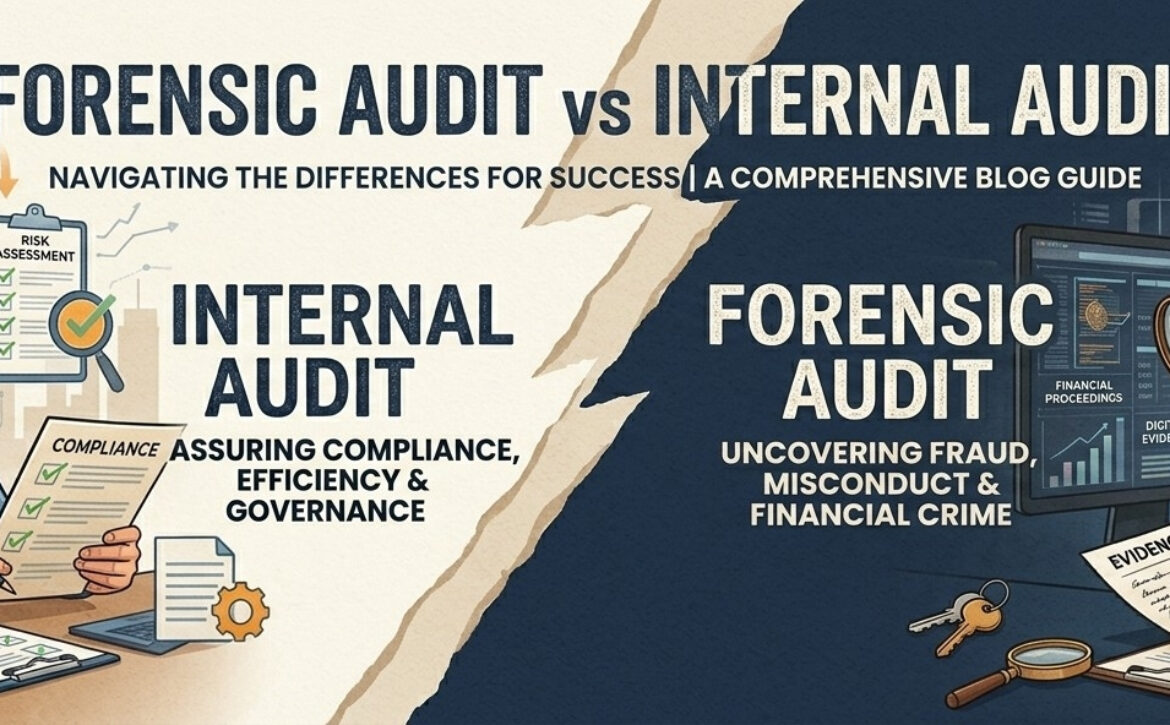
Forensic Audit vs Internal Audit
Forensic Audit vs Internal Audit: When to Use Each
In today’s competitive world, understanding the differences and purposes of both a forensic audit and an internal audit is very important! Businesses are required to protect their assets and ensure compliance at all times while doing business today. Understanding Forensic Audit vs Internal Audit will help improve financial controls, as well as give you better control over financial risks and make more effective decisions.
Companies in India face an increasing risk of non-compliance with laws and regulations, and the risk of fraud; therefore, every business needs to select and implement the right audit methodology. Understanding the important differences between Forensic Audit and Internal Audit. To better understand how you should use a forensic audit vs. an internal audit, you first must understand the two definitions.
Forensic Audit: An audit performed to investigate issues of financial fraud or misconduct. The primary emphasis is on collecting evidence and providing support for use in legal proceedings.
Internal Audit: An audit performed to assess the performance of business processes and internal controls for purposes of compliance with applicable laws, regulations, and policies; and to also support the adoption of “best business practices”, resulting in improved operational efficiency within the organization. Both of these have different purposes, so it is crucial to understand the differences.
Forensic Audit vs Internal Audit: When to Use Each
It provides a clear and easy-to-understand description of the major differences between these two types of audits. The primary purpose of a Forensic Audit is to identify potential fraud and investigate the occurrence of fraud. In comparison, the primary purpose of an Internal Audit is to prevent fraud and provide fraud control measures.
A Forensic Audit will typically follow a suspicious event, while an Internal Audit is conducted on an ongoing basis, as part of a regular process. Therefore, the timing and purpose of these audits are fundamentally different.
Purpose of Forensic Audit vs Internal Audit
The purpose of a forensic audit is to detect fraud and gather the necessary evidence for legal proceedings. In addition, a forensic audit helps with resolving litigation and dispute matters as well.
The purpose of an internal audit is to review and improve processes, reduce the likelihood of risk, and help ensure an organisation is compliant with policies and regulations. Therefore, there is a definitive reason for a business to use either an audit, depending on the business’s objective.
When to Use Forensics Audit vs Internal Audit
The difference between a forensic audit and an internal audit will be more apparent if you consider specific instances where you might use one versus the other. Utilise forensic audits when you suspect fraud or wrongdoing. Forensic audits will help identify financial irregularities and/or the parties responsible for the irregularities.
Utilise internal audits as part of ongoing monitoring and to assess the level of risk your organisation faces. Internal audits will assist in increasing operational efficiency, as well as improving the internal controls of your organisation. This will then allow for the ongoing growth and development of the organisation.
Benefits of Forensic Audit vs Internal Audit
Forensic audit and internal audit provide significant benefits to each organisation that utilises these two forms of audits. The primary benefit of utilizing forensic audits is to recover lost funds and/or prevent future fraud from occurring. In addition, the evidence obtained during a forensic audit also aids in building a successful legal case.
The primary benefit of an internal audit is to improve operational efficiency as well as to ensure organisational compliance. Internal audits will also assist in identifying and addressing potential risks before they develop. As a result, the organisation will maintain a stable and controlled environment.
Technology’s Role
The use of technology for forensic and internal audits has increased greatly. Auditors today can analyze financial data very quickly using digital tools. That allows them to detect anomalous trends and patterns within the financial data much more efficiently than before. In addition to improving the speed and accuracy of forensic audits, data analytics is also enhancing the ability of auditors to detect fraud. The use of automation in the reporting and monitoring process of audits will also increase audit effectiveness through technology.
Challenges of Forensic and Internal Audit
There can also be specific challenges to conducting forensic and internal audits. Forensic audits require specialized skills and detailed investigative procedures, which may make forensic audits expensive and time-consuming in comparison to internal audits. Internal auditors will likely face resource and expertise limitations, and as a result, they will need to continuously monitor and update their audits. Businesses will need to carefully plan their audit schedules to ensure they are able to manage their audit resources effectively.
The Importance
Forensic and internal audits are critical to the success of any business because each audit serves as a way for a business to balance its prevention strategies with its investigative strategies. Combining both types of audits provides a holistic approach to risk management for any business. Internal audits will help mitigate risks to the business proactively, and forensic audits will help address specific incidents of misconduct reactively. Ultimately, the business will achieve total control over its finances through the use of forensic and internal audits.
How Technology Will Shape the Future
The use of technology is improving how forensic auditors find fraud and conduct investigations, leading to faster and more accurate audit results. The regulatory environment becomes increasingly stringent, and as a result, the accounting profession must develop modern audit techniques. Audit functions will become more strategic in the future due to all of these factors.
By understanding when to use each type of audit, businesses can gain greater clarity in their financial management processes. Each type of audit serves an entirely different function in relation to a company’s financial management practices. Companies need to select the best audit methods for their requirements to ensure that their internal controls are functioning properly.
By utilising both forensic and internal audits in tandem, organisations can enhance their level of control over their activities and thereby increase their level of transparency. Combining these audits will help to ensure the long-term viability of an organisation.