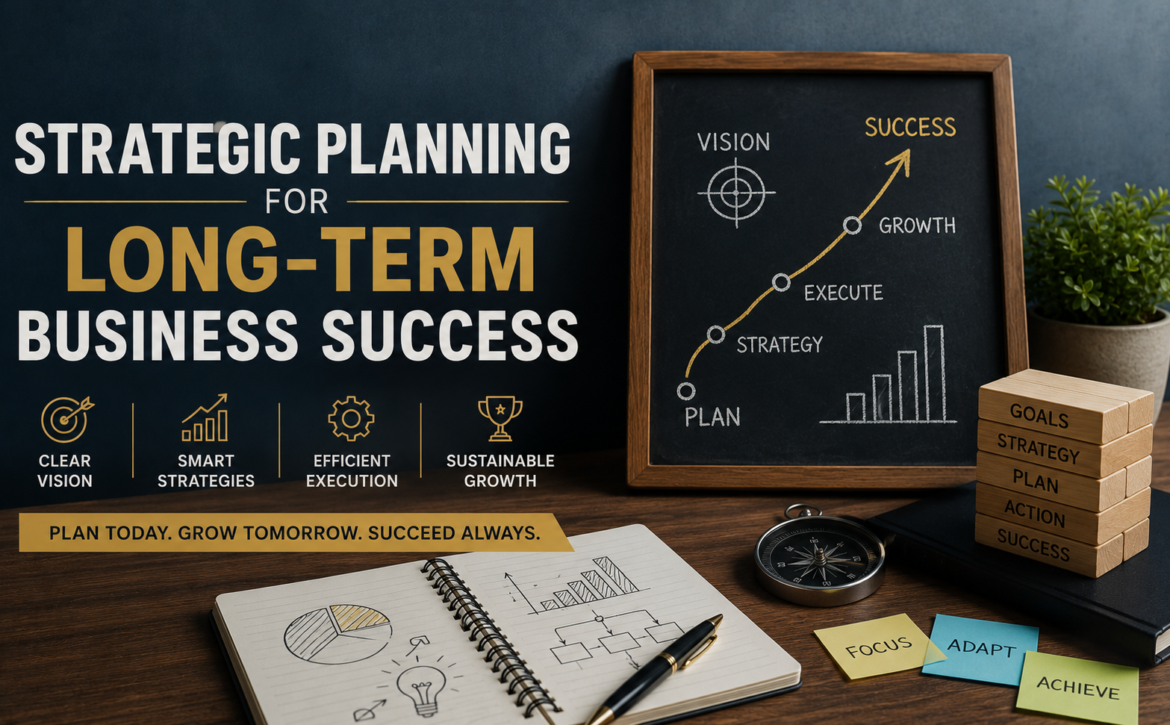
Strategic Planning for Long-Term Business Success
Strategic Planning for Long-Term Business Success
Strategic Planning for Long-Term Business Success is crucial for developing a well-defined course of action for sustainable growth. Because of the changing market, customer expectations, and competitive pressures, leaders must have a systematic plan available to help them handle unfortunate situations.
Having an excellent strategy implies that everyday tasks are linked to long-term business goals. At the same time, an organization benefits from the strategy by maximizing the allocation of the resources available and finding appropriate business opportunities. In addition, the organization can prepare for possible downturns before they produce any adverse effect on performance.
The Role of Strategic Planning for Long-Term Business Success
Strategic Planning for Long-Term Business Success begins with understanding business goals. Leaders should clarify what they want to achieve and create realistic time frames for achieving every goal. Then the business should proceed to assess its current position. For this purpose, it has to assess its financial condition, market position, customer demand, and the company’s internal capabilities.
Developing Concrete Business Goals
When it comes to Strategic planning for business success in the long run, reaching specific and measurable goals is essential. Organizations shouldn’t deal with vague objectives to eliminate confusion throughout the firm. Company leaders must set targets for their revenue, profit, expansion, and customer base. In addition, a clear connection must exist between each goal and any particular action. By doing so, the team may easily understand what responsibilities they have. Moreover, this also yields higher accountability throughout the organization.
Frequent performance evaluations help organizations assess progress. Thus, managers can modify their approach whenever results don’t meet their expectations.
Learning About Your Market
Understanding the market is crucial for effective strategic planning. Businesses need to be aware of their customers, competitors, and industry developments. Therefore, it proves to be useful to conduct market research on a constant basis before making major strategic decisions. Customer preferences change very quickly. Companies need to keep track of these changes to make necessary adjustments to their products or services. Competitor analysis may provide businesses with potential opportunities and gaps in the market.
At the same time, companies should stay updated on the latest technological and economic developments. Knowing these changes can help business leaders in anticipating possible shifts in the market.
Enhancing Financial Planning
Strategic Planning for Long-Term Business Success is dependent on effective financial management. Realistic budgets and accurate cash flow forecasts are needed for any business. Therefore, it should be clear that financial planning must support all strategic goals. Leaders need to systematically monitor revenues, costs, profitability, and working capital. This allows businesses to detect weaknesses in their financial position ahead of time. In addition, accurate financial data will help in making better investment decisions.
Besides, companies should have some emergency reserves to stay reliable in situations caused by market irregularities.
Risk Management
Any business experiences financial, operational, and market risks. Therefore, risk management is important in strategic planning. Companies must identify potential risks before making expansion plans. Strategic Planning for Long-Term Business Success requires companies to come up with effective risk management solutions. Management should evaluate all risks in terms of their consequences and likelihood of occurrence.
In addition, companies must develop backup plans for key processes. Periodic evaluations of potential risks allow the management to react promptly to changes in the environment.
Creating Efficient Operational Processes
Efficient operations make it possible for companies to grow sustainably. To do this, firms have to analyze and optimize their workflows. Hence, operational improvement should be part of any company’s strategic agenda. Strategic Planning for Sustained Business Success helps enterprises link operational efficiency to the attainment of their goals. Automation allows cutting down on repetitive work and improving accuracy.
Moreover, proper instructions lead to improved consistency in work between teams. Organizations can also apply the indicators of performance in tracking their operational outcomes.
Technology as a Tool for Strategic Development
Technology is influencing business operations to a great extent. Therefore, companies should include digital transformation in their strategic plans as well. Thanks to technology, productivity, customer service, and financial management can be improved. Cloud-based technologies improve information access. In addition, data analytics gives managers an opportunity to understand the performance trends and the behavior of customers.
Strategic Planning for Sustained Business Success suggests that companies need to analyze new technologies. They should invest in the instruments that can provide real benefits.
The importance of hiring the appropriate employees can never be underestimated in business. Hence, workforce planning must be in alignment with the strategic goals of the organization. It is essential to identify the competencies that will be needed for future progress. Staff training helps to acquire the necessary skills. Moreover, effective leadership fosters creativity and liability.
Companies should also be committed to the development of clear career paths. This can improve employee loyalty and contribute to organizational success.
Tracking Business Results
Strategic Planning for Long-Term Business Success means constant tracking of business performance. A company should avoid building strategies and forgetting about them. Corporate leaders must follow up on results periodically. Monitoring key performance indicators is essential for efficiency. Management should take these indicators into account when comparing them with the targets.
Additionally, routine strategy meetings help achieve quick identification of challenges. Thus, leaders can adjust the work as soon as possible.
The Important Role of Long-term Strategies in Adjusting to Changing Market Conditions
Flexibility is an important characteristic of long-term strategies. The ever-changing business environment: technology, market conditions, regulations, and customer needs influences strategic planning. Therefore, companies need to adapt while remaining focused on their main objectives.
It is better for companies to analyze their strategy regularly. The managers will be able to identify outdated assumptions and new opportunities since a flexible strategy helps to stay ahead of the competition. However, there is no need to change strategy unless it is necessary.
Benefits of Strategic Planning for Business Sustainability
The process of Strategic Planning for Business Sustainability provides organizations with a clear vision and enhanced financial insights. This methodological process also improves the process of decision-making and the efficiency of resource allocation. Moreover, strategic planning contributes to mitigating risks and enhancing operational efficiency. With strategic planning, teams have a clear understanding of their priorities and work on common goals.
Lastly, investors and other stakeholders appreciate organizations with pre-defined growth strategies. Therefore, strategic planning increases credibility and improves chances for future investments. Creating a strategic plan for sustainable long-term growth builds a solid base for the ongoing success of an organization. It draws a roadmap of the company through clear objectives, budget preparation, and market analysis.
Furthermore, well-thought-out strategies allow companies to anticipate risks and enhance their efficiency. Advanced technologies and competent personnel help maintain a company’s competitive edge in the long term. Companies must constantly revise their strategies and adapt to significant changes.