Importance of Bookkeeping for Small Businesses

Importance of Bookkeeping for Small Businesses

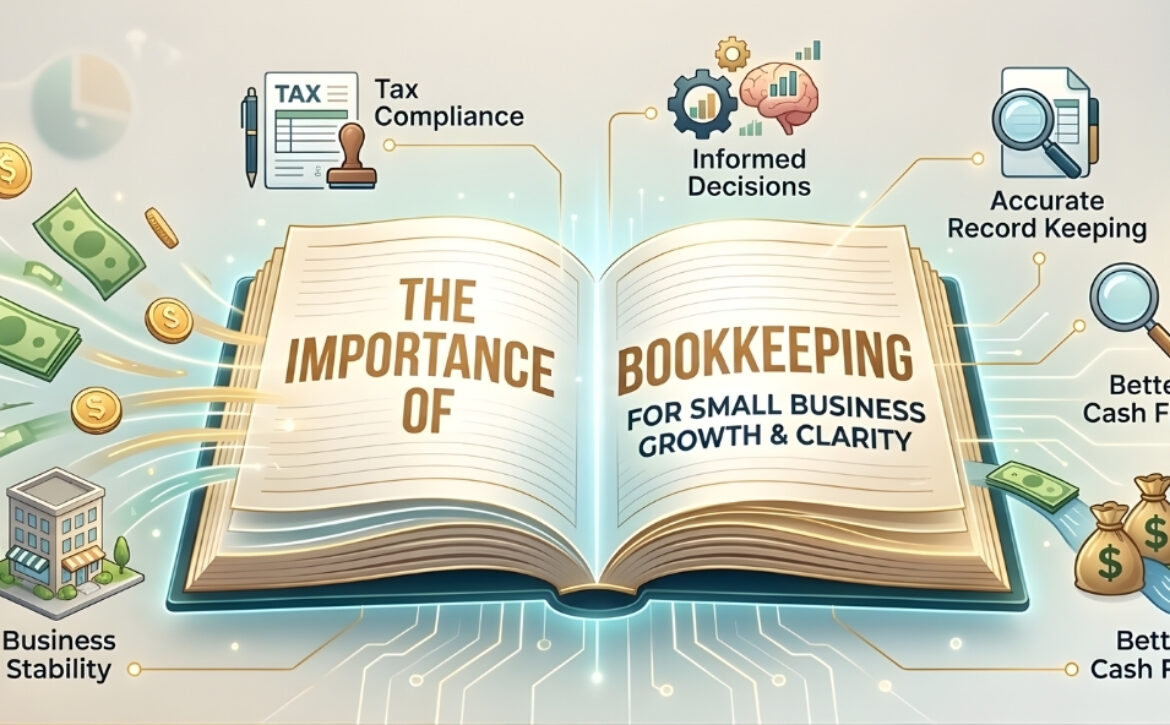
The Importance of Bookkeeping for Small Businesses is more prominent now than ever due to the competitive nature of the modern-day environment. Every firm must be able to accurately document its financial status to remain in business and continue to grow. Through bookkeeping, small business owners obtain control, clarity, and long-term financial stability. Furthermore, through bookkeeping, small business owners can make quick and informed decisions.

Understanding the Importance

Small businesses typically operate under a constrained budget and physical resources. Therefore, having established procedures for bookkeeping is imperative for managing their financial affairs effectively. The first step to understanding bookkeeping’s benefits for small businesses is establishing organized financial records.

Bookkeeping is nothing more than documenting every financial transaction that takes place in an organized manner. By systematically documenting all of a company’s transactions, a small business owner can have a comprehensive view of the company’s revenues and expenditures.

The necessity of maintaining accurate records can provide a greater level of transparency in the company’s finances. Having accurate records can assist in measuring the company’s performance over a time period, thus allowing company owners to run their businesses at their best potential to maximum efficiency.

Financial Accuracy

Bookkeeping is crucial for small businesses as it ensures accurate financial records. Errors in transactions can lead to serious issues, so a consistent bookkeeping system helps minimize discrepancies. Using good records to produce accurate and reliable financial information leads to establishing trends and patterns of cost, thereby increasing the efficiency of the day-to-day operations of the small business.

Cash Flow Management

Cash flow management has been heavily impacted by the way bookkeeping assists small businesses with their overall cash flow management. Small business owners need to monitor their incoming and outgoing cash regularly. As a result, proper bookkeeping helps keep the company in good standing financially.

When cash flow is tracked regularly through bookkeeping, it helps to keep businesses from running out of cash or having delays in making payments to suppliers or employees. Therefore, small businesses are able to maintain financial stability.

Tax Compliance

Bookkeeping plays a critical role in supporting small business owners when preparing their tax returns in a timely and accurate manner. In order for small business owners to accurately prepare their tax returns, they must use properly kept books.

Bookkeeping helps to reduce the possibility of errors when preparing tax returns by providing well-organised records that can be used for reference. Additionally, small businesses will be able to avoid penalties and threats of litigation as long as their bookkeeping records are kept properly. As a result, bookkeeping helps maintain compliance and credibility for small business owners.

Decision-Making

When it comes to making decisions, bookkeeping allows small business owners to make more informed decisions. Small business owners use financial data when developing a business plan and developing a strategy, which requires accurate financial records. Because of this, small business owners can gain valuable insights from their accurate records.

Financial reports can help small business owners identify areas that are profitable and areas that are not working, which will guide them to make more informed pricing management, budgeting, and investment decisions in the future. This will enable small businesses to achieve a greater level of success than they would have without the use of effective small business bookkeeping.

How Technology Is Helping Small Businesses Grow

The growing use of digital tools increases the importance of bookkeeping for small businesses. New accounting software greatly reduces the difficulty of doing bookkeeping tasks. This means that businesses can reduce human error and save time because they won’t be entering data manually.

Cloud-based systems allow for real-time updates to financial data. Automation allows for accurate and quick reporting. This makes financial management easier because it uses technology to help.

Reducing Financial Risk Of Bookkeeping For Small Businesses

The importance of bookkeeping for small businesses is essential in reducing the risk of financial loss. If you do not keep your records properly and accurately, you leave yourself open to potential fraud or mismanagement. So having the proper systems in place will give you the ability to be more accountable and transparent.

By having periodic reviews of your business’s financial status, you can detect errors or irregularities in your business’s financial records sooner rather than later. With the addition of internal controls to your business, you can improve your overall financial security. This, in turn, allows you to better safeguard your assets.

Growth Of Bookkeeping For Small Businesses

The importance of bookkeeping for a small business is necessary to support its long-term growth. By having accurate financial data, businesses have the ability to create an expansion plan. As a result, you will be able to allocate resources in an efficient manner. Investors and lenders will want to see accurate financial statements. When you have proper accounting records, you will increase your chances of being able to obtain funding from investors and lenders.

Outsourcing and The Need for Small Business Bookkeeping Increases With the Utilization Of Professional Assistance. An outsourced provider will decrease the amount of work you have to do while also ensuring that your work is being done correctly. Outsourcing allows you to concentrate on your main functions as a business.

Professional bookkeepers will ensure that your company is complying with all financial regulations and that your company is being properly managed financially. In addition, they will provide insight into how your company can grow, so as to ultimately be more efficient and reliable.

Small businesses rely on bookkeeping to be successful. Bookkeeping provides financial accuracy, compliance, and a way to plan. As a result, all companies should make bookkeeping a priority. Companies have a greater chance for stability and growth when they keep accurate financial records. Adequate bookkeeping lays the groundwork for a successful business long-term.

Read More

The Importance of Bookkeeping for Small Businesses in India

The Importance of Bookkeeping for Small Businesses in India

Bookkeeping is increasingly important to small businesses in India, particularly in the current competitive marketplace. Small businesses must keep track of their financials to continue to operate and grow. Proper bookkeeping provides these businesses with clarity, control over their business, and enables them to make informed decisions. It is also important for compliance purposes and ensuring sustainability over a long time horizon.

The financial landscape for companies in India is ever-evolving. Thus, maintaining accurate and up-to-date financial records is paramount for small businesses to successfully operate.

Understanding the Importance of Bookkeeping for Small Businesses in India

The Importance of Bookkeeping for Small Businesses in India starts with the tracking of financial records as they occur on a daily basis. This allows businesses to develop a good understanding of their overall financial health.

The accuracy of financial records will help business owners make good business decisions. In addition, the accuracy of financial records will increase the accuracy of financial budget preparation and financial planning processes. As a result, the business can operate with greater confidence and control.

Financial Accuracy and the Importance of Bookkeeping for Small Businesses in India

The Importance of Bookkeeping for Small Businesses in India is that it ensures accuracy in the company’s financial records. When a company has incomplete or inaccurate records, the business owner will not have adequate information on which to base his or her business decisions. Errors in record-keeping can result in poor business decisions, which will lead to business losses. Keeping accurate records with consistency from one period to the next reduces the possibility of mistakes and discrepancies.

With accurate financial records, a business can prepare reliable, timely financial reports and have accurate financial records, will be able to assist identifying historical trends in revenue and expenses. Additionally, accurate financial records allow businesses to improve operational efficiencies.

Tax Compliance & Bookkeeping’s Importance to Small Businesses in India

The importance of bookkeeping for small businesses in India is its contribution to tax compliance. Businesses are required to submit the correct GST and income tax returns for both GST and income tax purposes. Therefore, by maintaining accurate bookkeeping, businesses will be able to accurately calculate their taxes owed.

Having organized records will streamline a business’s filing of returns and the documentation required to support those returns. Organized records will also minimize the risk of penalties and legal issues so that companies can continue to remain compliant with the authorities.

Importance of Bookkeeping and Cash Flow Management

The importance of bookkeeping for small businesses in India supports cash flow management. Businesses must routinely monitor the inflow and outflow of cash from their business to maintain liquidity and stability. Therefore, maintaining accurate bookkeeping records will help a business to avoid financial shortages and to make timely payments to suppliers and employees. As a result, the business will not only continue to maintain its cash flow but also maintain financial discipline.

Importance of Bookkeeping and Decision-Making

The importance of bookkeeping for small businesses in India enhances business’ decision-making capability. Business owners make strategic decisions based on their financial data. Therefore, by keeping and maintaining accurate records, a small business will have access to valuable information to consider when making important decisions.

Using financial reports, a business can identify which areas are producing a profit and which areas are costing them money, in addition to assisting them in making pricing decisions and investment decisions. Consequently, the businesses will be able to achieve greater growth results.

Role of Technology in the Importance of Bookkeeping

The growing relevance of Bookkeeping for small businesses in India is established through the increasing automation of bookkeeping processes. Many businesses now use technology that makes the use and management of financial transactions easier, with minimal manual input required. As a result, this technology-based approach to bookkeeping reduces the number of errors made in bookkeeping and increases the efficiency of completing bookkeeping activities.

Cloud computing has provided new ways for businesses to track their financial performance. Innovations in finance software continue to drive increased accuracy and speed in reporting. Therefore, technology continues to improve and enhance overall financial management.

Risk Reduction and the Importance of Bookkeeping

The Importance of Bookkeeping for Small Businesses in India also helps lower the risk of financial failure. The risks associated with record-keeping include opportunities for fraud and poor management of the company’s funds. By having accurate record-keeping systems in place, the Company can achieve a higher level of transparency and accountability.

Reviewing records regularly will assist in identifying and minimising anomalies early. Strengthening internal controls allows a Company to better safeguard its assets.

Business Growth and the Importance of Bookkeeping

The Importance of Bookkeeping for Small Businesses in India ultimately supports the long-term growth of the Company. Businesses with accurate and consistent financial records are in a better position to have a well-defined strategy to support their expansion. As a result, companies can optimise their use of available resources.

Accurate financial statements are essential for businesses attempting to obtain financing from lenders or equity sources. Good and sound record-keeping enables a Company to improve its credibility and enhance its ability to obtain financing. As a result, by having good financial records, a Company is better positioned to expand its operations successfully.

Outsourcing Bookkeeping and How it Benefits Indian Small Business Owners

For small businesses in India, Outsourced Bookkeeping Service Providers offer them Professional Assistance for Simplifying Operations (i.e., reducing the Workload). As a Result, The Business Can Put Its Focus Back on Its Core Business. Outsourced Bookkeeping Professional Services Will Also Provide Businesses with the necessary financial compliance experience and Accuracy with Rules and regulations, and All The Information You Need to Understand How to Improve Your Operations Financially. They Will Increase Their Reliability By Providing Greater Operational Efficiency Through Their Professional Expertise.

As a Business Owner, You Should Not Underestimate the Value of Maintaining Accurate Bookkeeping Records, Especially In Today’s Business Environment, Since Accurately maintaining Your Books Is Essential for Ensuring Compliance, Control Over Your Finances as Well as Developing Great Business Plans for Future Growth. All Businesses Should be Dedicating Time and Resources to establishing strong bookkeeping records.

When Businesses Do a Good Job of Maintaining Accurate Bookkeeping Records, They Have a Much Greater Ability to Achieve Long-Term Business Stability And Success for the Future. A Business’s Bookkeeping Records Create the Foundation for Business Growth.

Read More