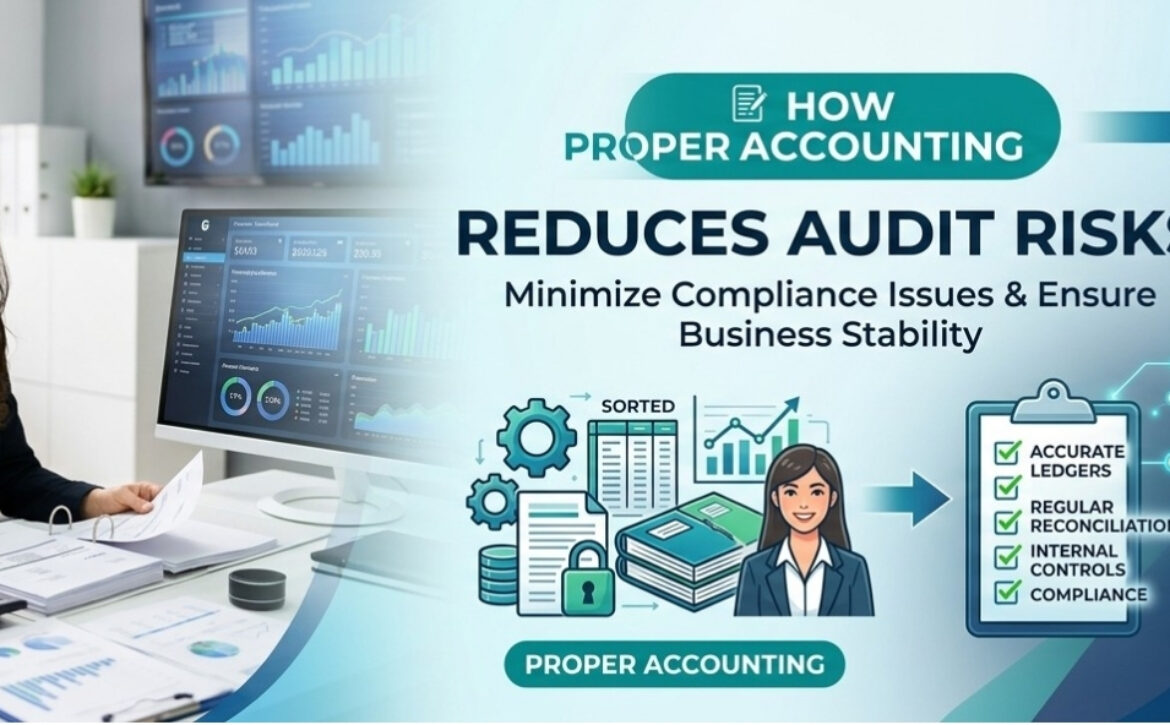
How Proper Accounting Reduces Audit Risks

How Proper Accounting Reduces Audit Risks

How Proper Accounting Reduces Audit Risks, is a key factor for all modern day businesses. Businesses must always keep track of their financial records. Proper accounting will help to avoid any errors and issues dealing with compliance. Proper accounting will also help to increase a business’s financial transparency and control. Due to the strict regulatory environment and the frequent audits businesses in India must contend with, strong accounting practices are a must for audit risk reduction.

Understanding How Proper Accounting Reduces Audit Risks

All businesses must keep an accurate record of all financial transactions. Through proper accounting, businesses will have a clear, organized way to store and access their complete financial information. When a business has clear records will allow an auditor to verify the information associated with the company. When there are clear records, it will help to eliminate discrepancies and confusion. As a result, the audit process will go quicker and smoother.

Financial accuracy and how proper accounting reduces audit risk

How Proper Accounting Reduces Audit Risks ensures that businesses will consistently have accurate financial information. If there are any errors in the accounting records of a business, it will raise concerns for auditors. If there are accurate accounting records, there will be no need for the auditors to review the company’s financial records for more detail than required because the auditor is getting accurate information that supports the company’s financial accuracy. Through proper accounting, any inconsistencies will be found early in the accounting process.

Also, through proper accounting, the company will produce accurate and reliable financial reports. As a result, the company will be able to significantly reduce its audit risk.

Compliance, and how proper accounting reduces audit risk

How Proper Accounting Reduces Audit Risks, helps businesses comply with federal and/or state and local regulations. Businesses must comply with IRS regulations and the financial reporting rules dictated by the GAAP. Through proper accounting, the company will ensure that tax filings and financial reports are accurate.

Keeping accurate records makes it easier for the business to verify compliance and lessen the potential of being penalized. Because of this, a company is able to keep its reputation in good standing with governing bodies.

The Use of Documentation and How Proper Accounting Reduces Auditing Risks

The ways that proper accounting can help to reduce auditing risk depend upon proper documentation. Businesses need to maintain their invoices, receipts, and accurate financial statements; therefore, having organized records will continue to support audit readiness.

Auditors require clear documentation to perform their work; therefore, having properly maintained records will provide them with the evidence needed to perform an audit with confidence.

Internally Maintaining Controls and How Proper Accounting Reduces Auditing Risk

The reduction of auditing risks through proper accounting is enhanced through strong internal controls. Businesses should have an appropriate system of checks and balances in their financial processes so that their internal control system effectively eliminates errors and fraud.

Regular monitoring of your business’s compliance with procedures improves and enhances the level of accountability among the departments of the business; as a result, a business can effectively reduce its auditing risk.

The Use of Technology and How Proper Accounting Reduces Auditing Risk

Accounting technology has increased the level of risk reduction associated with proper accounting practices. Accounting technologies help businesses automate their financial processes very effectively, and therefore, they reduce their manual errors. Cloud computing provides businesses with real-time access to accurate and up-to-date data. Because of this, the consistency of financial reporting through automation further enhances a business’s overall audit readiness.

Internal Controls and How Proper Accounting Reduces Audit Risks

The role of proper accounting in risk management involves improving the efficiency and effectiveness of businesses’ internal operations. They reduce uncertainties and increase transparency/accountability, creating a more efficient system overall. By identifying issues before they emerge, businesses can take corrective steps to address them early and reduce the likelihood of having significant issues later. As a result, they proactively mitigate risk.

Proper accounting provides several benefits to businesses

It improves financial organization and operational efficiency for a business; hence, the business operates in a much more effective and efficient manner. A business will have an increase in the level of trust with its stakeholders and regulators due to improved accounting practices. Proper accounting assists businesses in making better decisions, hence improving their ability to achieve long-term viability.

How Proper Accounting Can Improve Risk Management through Outsourcing.

Outsourcing the accounting function increases the ability of organizations to effectively reduce audit risk. Professional outsourced services assure accuracy and compliance with laws and regulations. As a result, organizations are able to reduce their workload and, consequently, reduce their audit risk. Professional outsourced services maintain records and ensure compliance with laws and regulations. Additionally, they provide valuable insights into the organization’s financial status.

Outsourcing enhances the accounting function in organizations.

The importance of How Proper Accounting Reduces Audit Risks in an organization’s success cannot be understated. Without accurate records, a business cannot demonstrate compliance with applicable laws and regulations. Therefore, businesses must have strong accounting practices in place.

Businesses that have a strong focus on proper accounting provide the foundation for a successful audit and avoid audit-related challenges. Strong accounting practices will provide businesses with a foundation from which they can grow and maintain stability.

Read More

Importance of Bookkeeping for Small Businesses

Importance of Bookkeeping for Small Businesses

The Importance of Bookkeeping for Small Businesses is more prominent now than ever due to the competitive nature of the modern-day environment. Every firm must be able to accurately document its financial status to remain in business and continue to grow. Through bookkeeping, small business owners obtain control, clarity, and long-term financial stability. Furthermore, through bookkeeping, small business owners can make quick and informed decisions.

Understanding the Importance

Small businesses typically operate under a constrained budget and physical resources. Therefore, having established procedures for bookkeeping is imperative for managing their financial affairs effectively. The first step to understanding bookkeeping’s benefits for small businesses is establishing organized financial records.

Bookkeeping is nothing more than documenting every financial transaction that takes place in an organized manner. By systematically documenting all of a company’s transactions, a small business owner can have a comprehensive view of the company’s revenues and expenditures.

The necessity of maintaining accurate records can provide a greater level of transparency in the company’s finances. Having accurate records can assist in measuring the company’s performance over a time period, thus allowing company owners to run their businesses at their best potential to maximum efficiency.

Financial Accuracy

Bookkeeping is crucial for small businesses as it ensures accurate financial records. Errors in transactions can lead to serious issues, so a consistent bookkeeping system helps minimize discrepancies. Using good records to produce accurate and reliable financial information leads to establishing trends and patterns of cost, thereby increasing the efficiency of the day-to-day operations of the small business.

Cash Flow Management

Cash flow management has been heavily impacted by the way bookkeeping assists small businesses with their overall cash flow management. Small business owners need to monitor their incoming and outgoing cash regularly. As a result, proper bookkeeping helps keep the company in good standing financially.

When cash flow is tracked regularly through bookkeeping, it helps to keep businesses from running out of cash or having delays in making payments to suppliers or employees. Therefore, small businesses are able to maintain financial stability.

Tax Compliance

Bookkeeping plays a critical role in supporting small business owners when preparing their tax returns in a timely and accurate manner. In order for small business owners to accurately prepare their tax returns, they must use properly kept books.

Bookkeeping helps to reduce the possibility of errors when preparing tax returns by providing well-organised records that can be used for reference. Additionally, small businesses will be able to avoid penalties and threats of litigation as long as their bookkeeping records are kept properly. As a result, bookkeeping helps maintain compliance and credibility for small business owners.

Decision-Making

When it comes to making decisions, bookkeeping allows small business owners to make more informed decisions. Small business owners use financial data when developing a business plan and developing a strategy, which requires accurate financial records. Because of this, small business owners can gain valuable insights from their accurate records.

Financial reports can help small business owners identify areas that are profitable and areas that are not working, which will guide them to make more informed pricing management, budgeting, and investment decisions in the future. This will enable small businesses to achieve a greater level of success than they would have without the use of effective small business bookkeeping.

How Technology Is Helping Small Businesses Grow

The growing use of digital tools increases the importance of bookkeeping for small businesses. New accounting software greatly reduces the difficulty of doing bookkeeping tasks. This means that businesses can reduce human error and save time because they won’t be entering data manually.

Cloud-based systems allow for real-time updates to financial data. Automation allows for accurate and quick reporting. This makes financial management easier because it uses technology to help.

Reducing Financial Risk Of Bookkeeping For Small Businesses

The importance of bookkeeping for small businesses is essential in reducing the risk of financial loss. If you do not keep your records properly and accurately, you leave yourself open to potential fraud or mismanagement. So having the proper systems in place will give you the ability to be more accountable and transparent.

By having periodic reviews of your business’s financial status, you can detect errors or irregularities in your business’s financial records sooner rather than later. With the addition of internal controls to your business, you can improve your overall financial security. This, in turn, allows you to better safeguard your assets.

Growth Of Bookkeeping For Small Businesses

The importance of bookkeeping for a small business is necessary to support its long-term growth. By having accurate financial data, businesses have the ability to create an expansion plan. As a result, you will be able to allocate resources in an efficient manner. Investors and lenders will want to see accurate financial statements. When you have proper accounting records, you will increase your chances of being able to obtain funding from investors and lenders.

Outsourcing and The Need for Small Business Bookkeeping Increases With the Utilization Of Professional Assistance. An outsourced provider will decrease the amount of work you have to do while also ensuring that your work is being done correctly. Outsourcing allows you to concentrate on your main functions as a business.

Professional bookkeepers will ensure that your company is complying with all financial regulations and that your company is being properly managed financially. In addition, they will provide insight into how your company can grow, so as to ultimately be more efficient and reliable.

Small businesses rely on bookkeeping to be successful. Bookkeeping provides financial accuracy, compliance, and a way to plan. As a result, all companies should make bookkeeping a priority. Companies have a greater chance for stability and growth when they keep accurate financial records. Adequate bookkeeping lays the groundwork for a successful business long-term.

Read More

The Importance of Bookkeeping for Small Businesses in India

The Importance of Bookkeeping for Small Businesses in India

Bookkeeping is increasingly important to small businesses in India, particularly in the current competitive marketplace. Small businesses must keep track of their financials to continue to operate and grow. Proper bookkeeping provides these businesses with clarity, control over their business, and enables them to make informed decisions. It is also important for compliance purposes and ensuring sustainability over a long time horizon.

The financial landscape for companies in India is ever-evolving. Thus, maintaining accurate and up-to-date financial records is paramount for small businesses to successfully operate.

Understanding the Importance of Bookkeeping for Small Businesses in India

The Importance of Bookkeeping for Small Businesses in India starts with the tracking of financial records as they occur on a daily basis. This allows businesses to develop a good understanding of their overall financial health.

The accuracy of financial records will help business owners make good business decisions. In addition, the accuracy of financial records will increase the accuracy of financial budget preparation and financial planning processes. As a result, the business can operate with greater confidence and control.

Financial Accuracy and the Importance of Bookkeeping for Small Businesses in India

The Importance of Bookkeeping for Small Businesses in India is that it ensures accuracy in the company’s financial records. When a company has incomplete or inaccurate records, the business owner will not have adequate information on which to base his or her business decisions. Errors in record-keeping can result in poor business decisions, which will lead to business losses. Keeping accurate records with consistency from one period to the next reduces the possibility of mistakes and discrepancies.

With accurate financial records, a business can prepare reliable, timely financial reports and have accurate financial records, will be able to assist identifying historical trends in revenue and expenses. Additionally, accurate financial records allow businesses to improve operational efficiencies.

Tax Compliance & Bookkeeping’s Importance to Small Businesses in India

The importance of bookkeeping for small businesses in India is its contribution to tax compliance. Businesses are required to submit the correct GST and income tax returns for both GST and income tax purposes. Therefore, by maintaining accurate bookkeeping, businesses will be able to accurately calculate their taxes owed.

Having organized records will streamline a business’s filing of returns and the documentation required to support those returns. Organized records will also minimize the risk of penalties and legal issues so that companies can continue to remain compliant with the authorities.

Importance of Bookkeeping and Cash Flow Management

The importance of bookkeeping for small businesses in India supports cash flow management. Businesses must routinely monitor the inflow and outflow of cash from their business to maintain liquidity and stability. Therefore, maintaining accurate bookkeeping records will help a business to avoid financial shortages and to make timely payments to suppliers and employees. As a result, the business will not only continue to maintain its cash flow but also maintain financial discipline.

Importance of Bookkeeping and Decision-Making

The importance of bookkeeping for small businesses in India enhances business’ decision-making capability. Business owners make strategic decisions based on their financial data. Therefore, by keeping and maintaining accurate records, a small business will have access to valuable information to consider when making important decisions.

Using financial reports, a business can identify which areas are producing a profit and which areas are costing them money, in addition to assisting them in making pricing decisions and investment decisions. Consequently, the businesses will be able to achieve greater growth results.

Role of Technology in the Importance of Bookkeeping

The growing relevance of Bookkeeping for small businesses in India is established through the increasing automation of bookkeeping processes. Many businesses now use technology that makes the use and management of financial transactions easier, with minimal manual input required. As a result, this technology-based approach to bookkeeping reduces the number of errors made in bookkeeping and increases the efficiency of completing bookkeeping activities.

Cloud computing has provided new ways for businesses to track their financial performance. Innovations in finance software continue to drive increased accuracy and speed in reporting. Therefore, technology continues to improve and enhance overall financial management.

Risk Reduction and the Importance of Bookkeeping

The Importance of Bookkeeping for Small Businesses in India also helps lower the risk of financial failure. The risks associated with record-keeping include opportunities for fraud and poor management of the company’s funds. By having accurate record-keeping systems in place, the Company can achieve a higher level of transparency and accountability.

Reviewing records regularly will assist in identifying and minimising anomalies early. Strengthening internal controls allows a Company to better safeguard its assets.

Business Growth and the Importance of Bookkeeping

The Importance of Bookkeeping for Small Businesses in India ultimately supports the long-term growth of the Company. Businesses with accurate and consistent financial records are in a better position to have a well-defined strategy to support their expansion. As a result, companies can optimise their use of available resources.

Accurate financial statements are essential for businesses attempting to obtain financing from lenders or equity sources. Good and sound record-keeping enables a Company to improve its credibility and enhance its ability to obtain financing. As a result, by having good financial records, a Company is better positioned to expand its operations successfully.

Outsourcing Bookkeeping and How it Benefits Indian Small Business Owners

For small businesses in India, Outsourced Bookkeeping Service Providers offer them Professional Assistance for Simplifying Operations (i.e., reducing the Workload). As a Result, The Business Can Put Its Focus Back on Its Core Business. Outsourced Bookkeeping Professional Services Will Also Provide Businesses with the necessary financial compliance experience and Accuracy with Rules and regulations, and All The Information You Need to Understand How to Improve Your Operations Financially. They Will Increase Their Reliability By Providing Greater Operational Efficiency Through Their Professional Expertise.

As a Business Owner, You Should Not Underestimate the Value of Maintaining Accurate Bookkeeping Records, Especially In Today’s Business Environment, Since Accurately maintaining Your Books Is Essential for Ensuring Compliance, Control Over Your Finances as Well as Developing Great Business Plans for Future Growth. All Businesses Should be Dedicating Time and Resources to establishing strong bookkeeping records.

When Businesses Do a Good Job of Maintaining Accurate Bookkeeping Records, They Have a Much Greater Ability to Achieve Long-Term Business Stability And Success for the Future. A Business’s Bookkeeping Records Create the Foundation for Business Growth.

Read More

Tax & Compliance Services in India

Tax & Compliance Services in India

Tax and Compliance Services play an important role in everyday business success. Companies need to abide by various legal and regulatory requirements while at the same time achieving maximum financial benefit through their work. Because of this tax, compliance services provide professional assistance to guide companies through their day-to-day operations without instances of non-compliance.

Avoiding notices or fines from the tax authorities allows a company to continue its operations.

Tax services and compliance services are continually evolving due to changing tax laws, regulations, and reporting requirements; companies must remain informed and take a proactive approach in providing compliance and performing compliance practices.

Why Tax & Compliance Services are Important to a Company

Tax & Compliance Services allow companies to maintain financial discipline and transparency. Companies need to be able to file an accurate tax return, keep accurate tax records, and maintain compliance with their respective regulatory authority in order to show their credibility to both investors and regulators.

Filing accurate tax returns on a timely basis minimizes the exposure to both penalties and audits. Accurate reporting of a company’s financial activity allows it to improve its long-term financial planning and decision-making processes and have long-term sustainable operations.

Types of Tax Services/Compliance Services

Typical tax services/compliance services would encompass many different aspects of a company’s financial activities, such as:

– Income tax
– UK Corporation Tax (UK Corporate Tax Planning/Corporation Tax)
– Goods and Service Tax (GST – GST compliance)/Tax compliance

Consequently, companies that use a tax service firm or a compliance service firm receive help with meeting their obligations to the various authorities.

In addition to providing support in completing regulatory filings, tax compliance professionals also assist their clients in ensuring compliance with relevant regulatory guidelines of government agencies/authorities, as well as industry standards. Therefore, all companies continue to perform their day-to-day activities without disruptions or loss of compliance with various regulatory authorities.

GST Compliance in Tax & Compliance Services in India

Tax and Compliance Services in India include the management of Goods and Services Tax (GST). Under GST, companies are responsible for filing GST returns accurately and on time. Therefore, if your company does not have proper GST compliance, you could face penalties or disruptions in business operations. Tax and compliance professionals can assist you in reconciling your input tax credits and ensure the invoices are in order. They can also help with ensuring that there is the correct classification for all transactions.
By providing this level of assistance, we help you maintain compliance with your GST obligations and to ensure the accuracy of your financial statements.

Corporate Tax Planning & Compliance

Tax & Compliance Services in India can also assist with effective corporate tax planning to enable your company to pay the least amount of taxes while complying with all applicable laws. Through strategic planning, companies can maximize the profitability of their business operations.

Tax professionals analyze your accounting records to develop strategies to minimize your company’s tax liability. They will also verify that you comply with current tax legislation. Consequently, by utilizing these professionals’ advice, your company will reduce the potential for tax audits and improve its financial performance of your company.

Technology’s Impact on Tax & Compliance Services in India

Tax & Compliance Services in India are rapidly adopting new technologies such as digital tools and automated compliance processes. Tax software applications make it easier for businesses to complete their tax calculations and meet their reporting requirements. Therefore, by implementing technology, businesses can streamline their operations and reduce the chance of human error.

Through cloud computing, companies have access to real-time data about the financial position of their business. By automating their tax compliance processes, companies can file taxes in a timely manner and have a sufficient level of supporting documentation for their tax returns. As a result, technology is enabling businesses to better manage their compliance activities.

Outsourcing Tax & Compliance Services in India: Benefits

When Tax and Compliance Services are outsourced to professionals in India, they become more effective. Outsourcing Tax and Compliance Services can help reduce the internal workload and costs associated with a company’s operations, allowing it to devote more time to its core operations.

The professional firms provide expert knowledge and skills related to Tax and Compliance Services. They stay current with changes to the regulatory environment and compliance requirements, improving the accuracy and efficiency of compliance for businesses.

Challenges Associated with Tax & Compliance Services in India

Companies face multiple challenges when providing Tax and Compliance Services in India. Due to the rapid pace of change in regulations, businesses experience challenges in complying due to the complexity created by the frequency of regulatory updates.

Due to the reliance on manual systems, companies have a higher likelihood of making mistakes or experiencing delays. Furthermore, due to a lack of knowledge or expertise, a company may be at risk of non-compliance.
As a result, professional guidance is critical.

Risk Management Through Outsourcing Tax and Compliance Services in India

Tax and Compliance Services support a company’s ability to manage risk by addressing its financial or regulatory risks. By ensuring adequate documentation is available, companies reduce the likelihood of being at audit risk. As a result, companies are able to maintain transparency in their financial reporting.

Regular reviews for compliance will identify issues before they become problematic. Taking corrective action eliminates the possibility of penalties or legal complications. As a result, businesses can operate with confidence.

Tax and compliance services in India are expected to evolve, incorporating technology as well as new legislative requirements. Automated systems for tax compliance and artificial intelligence will improve the compliance process for many businesses by automating some of the work.

As digital reporting systems enhance transparency and efficiency, regulatory frameworks will become more comprehensive. This means that compliance will become more integrated into business strategy.

Future Trends in Tax & Compliance Services in India

Tax and compliance services will be a key driver of sustainable business growth in India, helping to ensure that companies comply with their legal obligations, accurately report their financial performance, and effectively manage risk all of which are critical to success. As a result, companies need to ensure that they prioritize compliance as part of their business operations.

By utilizing professional services to meet their compliance obligations, organizations have the opportunity to increase their overall level of operational efficiency and improve their credibility. Ultimately, businesses that develop strong compliance-related practices will be more successful over the long term in India.

Read More

Future of Account Bookkeeping in India

Future of Account Bookkeeping in India

In the prospect of Account Bookkeeping in India is an example of the evolution of methods for managing finances in businesses. Companies are transforming the way they manage, record, and organize their accounting information due to rapidly moving advances in technology.

As such, organizations are turning to modern bookkeeping systems to achieve enhanced productivity and accuracy in performing their bookkeeping duties. Businesses in India are increasingly reliant on using digital technology to manage their financial affairs.

As a result, bookkeeping is quickly changing from paper-based processes to automated systems for carrying out financial transactions.

Technology and The Future Of Account Bookkeeping In India

The future of Account Bookkeeping In India has a significant reliance on the use of technology. Businesses are implementing cloud-based accounting programs to provide easy access to and better organization of their accounting data.

As a result, businesses can now monitor their transactions and maintain their accounting records on a real-time basis. Automation also allows for a reduction in repetitive tasks and decreases in human errors associated with performing accounting functions. Digital platforms also enhance the collaboration of accountants and business owners.

Therefore, technological advances are improving the accuracy and productivity of financial management.

Automation Trends In The Future Of Account Bookkeeping In India

The Future of Account Bookkeeping In India will continue to experience increasing levels of automation across accounting functions. Currently, many businesses are employing artificial intelligence to classify their financial transactions automatically.

Therefore, accountants are being allowed to concentrate an increased amount of their time on providing financial analysis and conducting strategic business planning.

In addition, automated systems can provide instant generation of a business’s financial reports. This capability will provide greater transparency for businesses as well as improve the overall ability to monitor business performance. Consequently, automation will also lead to an increase in the productivity of the accounting profession.

Future Account Bookkeeping (India) Compliance & Regulation

The future of bookkeeping in India will require rigorous compliance with financial regulations. There is a clear demand for accurate reporting and transparency in accounting for businesses, which means they must keep organized and current financial records.

Digital bookkeeping simplifies the complexities of managing compliance. Digital bookkeeping allows businesses to track tax obligations and deadlines, allowing them to minimize the risk of penalties or audits.

Cloud Accounting Future of Bookkeeping (India)

Future bookkeeping in India will be more cloud-based than ever before. A cloud-based financial system provides businesses with access to their financial data securely, from anywhere. This has greatly enhanced their ability to be flexible and to operate efficiently.

Real-time updates create opportunities for accurate financial tracking and monitoring. Cloud-based solutions also offer secure data backups. This provides businesses with better protection of their financial record against data loss or cyber-attacks.

Future of Accountants in Bookkeeping (India)

The role of accountants and their focus on bookkeeping in India will change dramatically going forward. Accountants will place greater emphasis on advisory services and financial analysis; therefore, accountants will play a critical role in the overall strategic planning of the business.

Accountants interpret financial data to assist businesses in making decisions. Their expertise helps businesses to increase profitability and mitigate risk. As a result, accountants will continue to be integral partners in the growth of the business.

Account Bookkeeping in India: Future for Small Businesses

The future of bookkeeping in India has the potential to significantly assist small and medium-sized enterprises. Digital bookkeeping services help growing companies with their ability to manage their finances; therefore, this allows SMEs to decrease their administrative and operating cost burden.

Quality, inexpensive accounting software includes many valuable features for day-to-day bookkeeping. As a result, this enables entrepreneurs to gain greater insight into and control of their respective finances.

Furthermore, through enhanced financial discipline and better financial planning, small businesses can improve their financial health.

Data Protection in the Future of Bookkeeping in India

The future of bookkeeping in India focuses on data protection. Many businesses keep their financial data in digital systems that contain sensitive information.

As such, businesses must put proper cybersecurity measures into place. Financial data can be protected by encrypted data and secure backup procedures. Additionally, regular system monitoring will identify any possible threats to that data early on.

This will allow businesses to continue operating while maintaining their credibility.

Integration with Other Business Systems

The future of bookkeeping in India will bring about the integration of accounting (bookkeeping) systems with other operational business systems. Most of the accounting (bookkeeping), inventory, payroll, and sales systems being used today are linked.

Thus, this integration will ensure that financial records are always consistent. By integrating these systems, businesses will be able to eliminate double data entry. By integrating systems together, businesses will be able to produce complete financial information far more quickly, which will allow for better and more efficient decision-making.

Skill Development For The Future Of Account Bookkeeping In India:

Professional development via continuous skill development is essential to accounting’s future. Accountants must utilize digital tools and utilize increasingly sophisticated technology tools. Thus, there are numerous training programs available to assist professionals in developing skills.

In response to the growth of technology, many educational institutions now offer technology-specific accounting courses to help professional accountants prepare for the financial markets of the future. As a result, today’s workforce is better equipped to meet the changing demands of bookkeeping processes.

Future Opportunities for the Future Of Account Bookkeeping In India:

The future of accounting will have numerous opportunities for many accountants. Digital transformation will fuel the growing demand for bookkeeping professionals who possess the skills necessary to operate in a rapidly changing world. Thus, accounting professionals with experience and knowledge of technology will have competitive job advantages.

Accounting professionals will additionally have many opportunities available to be consultants or advisors in business financial planning. This growing demand will create new accounting positions, as bookkeeping continues to evolve into a more strategic and innovative profession.

The future of bookkeeping in India will emphasize the movement from traditional bookkeeping to digital and automated financial management. Bookkeepers’ use of technology, compliance, and their professional knowledge will be the driving force behind this transformation. Therefore, in order for businesses to succeed, they will need to learn how to implement modern-day bookkeeping processes.

Businesses that are willing to innovate will create a more efficient and transparent financial management system, and ultimately, the future of bookkeeping in India will support long-term, sustainable growth of businesses.

Read More

Long-Term Investment Planning for Dubai Real Estate

Long-Term Investment Planning for Dubai Real Estate

Long-Term Investment Planning for Dubai’s real estate market supports long-term wealth creation in Dubai. With a robust infrastructure, international networks and regulations favouring investors, investors are encouraged to adopt systematic methods in order to achieve long-term stable returns. Proper planning reduces risk, enhances returns on long-term property portfolios and increases long-term portfolio performance.

Dubai is internationally liked by buyers looking for a haven and a place of growth. Moreover, the widely accepted regulations encourage stronger relationships with investors. Thus, long-term strategies produce dependable results.

Market fundamentals

Long-Term Investment Planning for Dubai’s real estate market begins with understanding market fundamentals.
Market supply trends, demand drivers, and price cycles are critical to long-term investment performance. Hence, investors should assess statistical data before they buy real estate in Dubai.

Population growth has created a need for housing in many of Dubai’s prominent areas.
As infrastructure continues to expand, property in these areas becomes increasingly valuable and accessible.
Thus, understanding the market fundamentals forms the basis for developing a Long-Term Strategic Investment Plan in Dubai’s real estate market.

Location selection is a key component

Prime location provides a consistent rental demand and a consistent capital gain. Therefore, the assessment of location should focus on proximity to public transport, availability of amenities and the future available supply of properties due to planned projects being developed.

Emerging communities may provide better initial pricing than prime location communities.
However, due to strong demand for prime location communities over the long-term, the potential returns of a balanced location strategy will outperform the return on investment of emerging communities.

Financial Planning

The importance of disciplined financial planning cannot be understated when it comes to Long-Term Investment Planning for Dubai Real Estate. This element of Financial Planning includes calculating acquisition costs, financing costs and ongoing maintenance requirements.
To ensure long-term profitability, investors must prepare accurate budgets. This will allow for proper cash flow analysis of rental income to determine if sufficient funds are available to meet expenses. It is imperative for investors to properly manage their debt obligations in order to reduce overall financial pressure during times of market volatility.
An investor’s ability to achieve financial discipline increases the resilience of their overall investment.

Risk Management

Proactive Risk Management is a critical component of Long-Term Investment Planning for Dubai Real Estate. Market fluctuations, periods of vacancy and changes to regulatory frameworks adversely affect the financial performance of properties in Dubai.
To mitigate performance risk, investors must have a strategy that incorporates asset diversification and performs regular monitoring of risks.

Investors need to also utilize insurance coverage to protect the value of their investment properties as well as reduce the negative effects of unforeseen events impacting current rental income. Regular reviews provide investors with the ability to identify emerging risks early in the risk cycle, which provides investors with the proper time to take corrective action to ensure their portfolio continues to maintain its security.

Regulatory Considerations

Local regulatory compliance is an essential element of Long-Term Investment Planning for Dubai Real Estate. The relevant governmental authority expects investors to provide accurate and transparent documentation related to their ownership interest. To ensure compliance with local regulations, investors will need to carefully follow the legal procedures required for completing the registration processes that provide secure ownership rights.
Failure to comply with the legal registration requirements negatively impacts the credibility of the investor. Therefore, to ensure that their long-term investments remain secure, investors will benefit from legal clarity.

Strategies for Optimizing Your Rental Yield

The long-term investment strategy regarding Dubai real estate is to maximize the overall sustainability of the rental yield. The property’s condition and the quality of tenants will dictate the long-term sustainability of your income. Thus, the investor has the responsibility of proactively maintaining the property.

When you have professional management, the retention rate of your tenants will increase. Additionally, by being competitive with your pricing, you will attract long-term tenants; thus, the rental income remains consistent, ensuring you reach your financial goals.

Portfolio Diversification as part of Long-Term Investment Strategy for Dubai Real Estate

Long-Term Investment Strategy for Dubai Real Estate will benefit from having a diversified portfolio. An investor can combine residential, commercial and off-plan properties to reduce their risk to any single market. Different types of properties react differently to changes in the market; therefore, a balanced portfolio can help sustain long-term performance. Thus, by diversifying, you will improve the overall performance of your portfolio.

Technology and Data Through Long-Term Investment Strategy for Dubai Real Estate

Long-term investment strategy for Dubai real estate is increasingly dependent on technology and analytics. Digital technology is allowing investors access to real-time market information and tracking of performance. Therefore, investors are able to make quicker and more informed decisions.

Through the analysis of data, investors can identify trends of growth and pricing. Automation of financial tracking and reporting will improve the accuracy of financial management. Therefore, technology will enable the investor to enhance their overall investment strategy.

It Requires Careful Assessment of Financing Options

When planning for a long-term investment in Dubai real estate, it is important to carefully assess your financing options.
The structure of your mortgage affects both the long-term profitability of your real estate investment and the stability of the cash flow generated by it, so it is important for investors to fully compare their interest rates and repayment options.

Using fixed-rate financing gives you predictable payment amounts, while flexible repayment options provide liquidity management. Thus, structured financing helps investors achieve long-term sustainability.

Long-Term Investment Planning for Dubai Real Estate Can Create Wealth Over Time

Long-term investment planning for Dubai real estate can provide investors with wealth accumulation over a period of time through both property appreciation and rental income. Therefore, investors who are patient and have a long-term strategy will see greater overall return on investment.

Reinvesting your profits accelerates the growth of your portfolio, and by closely monitoring your investments, you will be able to ensure that your investments are aligned with your financial objectives. Thus, investors can achieve sustainable wealth growth.

A well-planned long-term investment plan for Dubai real estate provides an investor with a roadmap to financial stability. Successful investing requires an investment strategy based on selecting the right location for your properties, being disciplined in your financing, and managing risk. As a result, investors must establish their plans and follow them consistently.

Investors who implement long-term plans will experience more successful results than those who are looking for short-term returns. In the end, properly planned long-term investments in Dubai real estate will provide investors with an exceptional opportunity to create wealth.

Read More

UAE Tax Incentives 2026

UAE Tax Incentives 2026

The UAE Tax Incentives 2026 provide various strategic benefits for businesses operating in the UAE. The UAE has developed as a significant centre of global investment. So, tax incentives and allowances provide advantages to businesses to encourage continuing growth in the economy. Businesses must acknowledge the benefits available via the UAE Tax Incentives 2026, so they are able to maximise both profits and compliance.

The UAE Government aligns its incentives to support investment, innovation, diversification and global standards. As a result of these incentives, companies have many opportunities to legally reduce their tax liabilities.

What Are UAE Tax Incentives 2026

The UAE Tax Incentives 2026 programme provides tax incentives to businesses in many industries. The UAE Government has created tax incentives to promote investment and to create jobs.
All businesses should carefully consider the eligibility criteria associated with each incentive. Tax incentives may take the form of tax exemptions, tax relief and preferential tax rates. Each of these incentives is available under certain conditions and circumstances. A comprehensive understanding of the tax incentives provided by the UAE Tax Incentives 2026 will facilitate the implementation of an appropriate tax planning strategy.

UAE Tax Incentives 2026 provide various reliefs under the Corporate Tax framework that are available to Corporations and SMEs (small and medium-sized enterprises). Specifically, the threshold limits for MSMEs will result in reduced compliance, thus lowering the burden of compliance on MSMEs. The carry forward allowance of losses will aid in a corporation’s ability to recover and grow, as Corporates will be able to offset future profits against their previously incurred losses. Therefore, the relief will provide increased stability in cash flow.

Free Zone Benefits and UAE Tax Incentives 2026

It also maintains the benefits for eligible Corporations in Free Zone areas. However, a free zone entity must comply with the requirements of economic substance. Therefore, the business must have an operational ‘presence’ in the free zone. UAE Tax Incentives 2026 also provide a preference by providing eligible Corporations with preferential tax treatment on qualifying income; however, Corporations that do not meet the qualification criteria will be taxed at the standard Emirate Income Tax rates. This creates segregation of income by providing compliance and a continuance of the tax incentive(s).

Research and Innovation Incentives

In an effort to promote innovation and the development of technology, the UAE Tax Incentives 2026 encourage businesses to adopt research or research-model-based business through the availability of tax deductions for innovation.

Corporations that are primarily focused on technology will continue to have long-term strategic advantages through the innovation incentive. Using innovation incentives will provide support for Corporations to continue to grow their businesses while remaining aligned with national priorities. It will bring international investors to the UAE for tax-efficient markets.

Foreign Investment and Tax Incentives

The UAE has an extensive network of double tax treaties. Therefore, businesses that operate outside their home country will have less exposure to tax through cross-border operations.

The UAE’s investment incentives give investors confidence to enter new markets. The clear regulations provide the ability for businesses to operate transparently. As a result, many investors have chosen to base their regional headquarters in Dubai.

Economic Substance’s Role in 2026 Incentives Eligibility

The UAE’s Tax Incentives for 2026 match the benefit of the incentives with the true economic activity of the company. To be able to retain the incentive, a company must show that they have local management and operations. Shell companies do not qualify for the incentives since they don’t have real local management or operations.

The substance requirements of the incentives help create an environment of real businesses being established and operating in the UAE. This also increases the credibility of the UAE’s regulatory and taxation systems. As a result of these requirements, companies that are committed to developing their business in the UAE will receive more benefits than those that are only using the UAE as a conduit to their real business in another country.

Compliance and Documentation Requirements

The UAE’s Tax Incentives for 2026 require that companies document and report their records accurately, as well as to have accurate financial records. Therefore, companies require robust accounting systems.

The authorities expect that there will be consistency in the information reported in the tax return and in the financial statements. It is important to remember that if there is incomplete documentation, the company could lose the ability to claim the incentives. A regular review process will help to close compliance gaps.

Tax Planning Strategies for 2026

UAE’s Tax Incentives for 2026 can be very useful in creating an effective tax plan for a company. It is recommended that companies evaluate their corporate structures and operations on an annual basis. If a company starts to develop its tax planning early, it can take full advantage of the tax benefits.

Businesses are encouraged to work with professional advisors to help them evaluate the continuously changing regulations. By working with a professional, businesses can avoid the misinterpretation or penalties that can occur if they do not fully understand the regulations. As a result, businesses will have a strategic advantage when planning their taxes.

UAE Tax Incentives 2026

Tax incentives in the UAE in 2026 offer opportunities for businesses, but navigating complex eligibility requirements can be challenging. Companies may struggle with application processes and risk non-compliance if they use incorrect procedures or documents, potentially missing financial rewards.

Continually monitoring and adapting to the new regulatory changes will require commitment and due diligence on the part of the company, while partial compliance will result in reduced benefits. Therefore, sound governance of all tax compliance and reporting will be essential to ensure that companies are in a position to obtain timely compliance with the Incentives.

Preparing Your Business to Qualify for UAE Tax Incentives 2026

Preparing for and assessing tax incentive opportunities in the UAE, 2026 will be a proactive initiative for your company as you begin to conduct incentive eligibility reviews to maximise incentives that may be available to you.

Training finance team members on the various tax incentives will enhance the knowledge of these team members and allow for accurate reporting. Technology will help your company report accurately by providing the tools necessary to remain ready to obtain tax incentives.

Long-Term Benefits of UAE Tax Incentives 2026

Accessing the UAE’s tax incentives for 2026 will help to ensure long-term sustainability for your company by establishing a lower tax liability, which will allow your company to reinvest significantly. Businesses will have more confidence as they expand their business operations.

Incentives will boost investor confidence and market reputation, promoting growth through partnerships and joint ventures. UAE tax incentives in 2026 will foster strong, sustainable business ecosystems. UAE Tax Incentives 2026 offer substantial savings for compliant companies. Understanding these incentives provides a strategic advantage, and early planning minimises risks, increasing profitability. Companies that act early with proper guidance will benefit most from tax incentives and support sustainable growth in 2026 and beyond.

Read More

UAE Corporate Tax 2026

UAE Corporate Tax 2026

The 2026 UAE Corporate Tax transforms company operations, aligning them with global standards. Companies must understand these changes to ensure compliance and competitiveness while preparing early to mitigate risks and plan finances. The UAE government prioritizes transparency and accountability, requiring companies to adjust their systems and tax strategies to align with new regulations for sustainable revenue.

Understanding the Corporate Tax for the year 2026

The 2026 Corporate Tax uses the existing structure to improve compliance and reporting in the UAE. It will apply to both Mainland and Free Zone Entities, with companies needing to assess eligibility for exemptions. A proper understanding of their tax compliance requirements will prevent potential costs and penalties resulting from mistaken assessments.

Potential Changes under Corporate Tax for the year 2026

The Corporate Tax for 2026 could include refinements to the reporting and disclosure requirements; however, the expectation for enhanced documentation and audit readiness will increase significantly for Companies. Therefore, Companies must ensure that they have accurate and complete financial records.

Transfer pricing rules will also receive increased oversight due to business instances involving related parties. All companies with related parties will need to support their pricing arrangements with documentation to demonstrate compliance. Failure to comply with this requirement could result in potential audits and penalties for the business.

Effects of UAE Corporate Tax 2026 on SMEs and Large Corporations

The Corporate Tax in the UAE will have an effect on all businesses. Small and Medium Enterprises (SMEs) will benefit by carefully analyzing the thresholds for profits and what is required when filing taxes. Many small and medium-sized businesses do not previously plan for taxes. The beginning of tax reporting will reduce financial burdens for small and medium-sized businesses.
Large businesses have additional responsibilities regarding their tax governance and systems for managing tax risk. The complexity of the corporate structure requires assistance from tax planning experts.

Requirements for Filing and Compliance

The Corporate Tax in the UAE requires the timely and accurate filing of tax returns. To avoid financial penalties, companies must file their tax returns by the deadlines set by the regulatory authority. If businesses file their tax returns after the prescribed deadline, they will incur financial penalties and will be subject to additional regulatory oversight. Also required of businesses are proper filing of tax returns along with required financial disclosure documents to support the information contained within each tax return. Regulatory authorities expect that there is consistency between the tax returns filed and the financial statements issued by businesses. To ensure compliance, businesses must have well-defined processes for reconciling their tax returns and their financial statements.

The Importance of Accounting Systems and Technology for Filing and Compliance Under UAE Corporate Tax 2026

With the introduction of the Corporate Tax in the UAE, businesses will now be more reliant on the use of electronic accounting systems. The manual nature of financial recordkeeping creates the potential for errors in compliance with tax laws and regulations. Therefore, all businesses should adopt automated accounting systems that provide for accurate and timely reporting.

The use of automated accounting systems allows for timely and accurate reporting of all transactions. The use of automated accounting systems streamlines the process of preparing for audits and calculating taxes. As such, businesses should invest in technologies that will allow them to continue complying with all applicable tax laws.

Importance of Tax Planning in UAE Corporate Tax 2026

Tax planning continues to be an important consideration for corporate tax in the UAE. Businesses need to review their organizational structures, their expense policies, and their revenue recognition policies as a result of the enactment of the Corporate Tax in the UAE. The implementation of a tax planning strategy will allow businesses to stay legally compliant while minimizing their tax liability.

The UAE Government has set criteria for Free Zone status, effective 2026, with Corporate Tax. Companies must meet these criteria to retain benefits; non-compliant income will be taxed.

Therefore, Free Zone Companies need to monitor and segregate all income into qualifying and non-qualifying categories. Regular Income Statements and Reviews will guarantee that companies do not incur any unanticipated tax liabilities.

Strengthening Governance and Internal Control Systems

Improvements in the Governance and Accountability Systems will allow UAE Corporate Tax applicants to increase their focus on Internal Controls and Accountability for Taxation reporting. Companies that implement strong Internal Control systems will have a higher level of confidence in their tax reporting. Tax Compliance workflows and approvals should be established within the management structure of all companies applying for UAE Corporate Tax.

In addition, Companies should perform Regular Internal Audits to help identify non-compliance areas early on to eliminate future Tax Compliance Risk. Preparing Your Company for UAE Corporate Tax in 2026

The successful preparation of the company for the UAE Corporate Tax 2026 will enable companies to successfully adapt to the Taxation system introduced in 2026. All Companies should perform a Tax Impact Assessment as soon as possible to identify potential risks and improvement areas, and also provide their Financial Staff with Regular Training regarding Tax Awareness. Conducting Regular Training for Financial Staff will not only increase awareness regarding compliance but will also increase operational efficiency. Additionally, obtain Professional Advisory Services to assist with Strategic Planning.

Consequences of Non-Compliance

Penalties for violating the new law could be detrimental to business cash flow and reputation; in turn, non-compliance could lead to a regulatory investigation, disrupting a business’s day-to-day practices. Proactive compliance helps avoid the potential for future legal disputes and unnecessary expenses that may arise. All compliant companies create a bond of trust between themselves and the regulatory agencies and are respected and trusted stakeholders.

The establishment of a new UAE Corporate Tax certificate with an effective date of 1 January 2026 is a significant change in the tax environment of the UAE and requires businesses to focus on becoming educated about the law and plan accordingly. The best way to minimize risks is to start early, preparing for compliance with the new law.

Additionally, businesses that embrace compliance not only reduce risks but also increase their profitability and long-term stability. From the perspective of a business owner, building preparedness now provides future success.

Read More

Strategic UAE Internal Audits

Why Internal Audits Are Becoming a Strategic Tool for UAE Businesses

As the business landscape evolves rapidly, organizations in the United Arab Emirates (UAE) must contend with changing rules and regulations, digital transformation, and international competition. As a result, many organizations have considered changing their approach to risk management and compliance. This is where Strategic UAE Internal Audits have a significant role to play. Organizations are no longer viewing internal audits strictly as a regulatory requirement, but rather viewing them as a method of driving efficiencies, protecting assets, and creating long-term resilience.

From Compliance to Strategic UAE Internal Audits

Audits were traditionally viewed as simply ensuring that the organization was following the laws and industry regulations. However, the business landscape in the UAE is changing. With the drive for reporting transparency, corporate governance, and digital innovation, organizations are now realizing that internal audits can be a strategic tool for businesses in the UAE. Not only do they identify risks, but they can also provide actionable insights that support decision-making and long-term growth.

For example, today’s internal auditors are playing a proactive role by not only identifying gaps in operational processes and fraud, but also recommending improvements in resource utilization. This puts internal auditing in the role of a partner in growth rather than the role of a watchdog.Strategic UAE Internal Audits

Establishing Trust and Transparency

A primary concern for businesses in the UAE is sustaining trust with various stakeholders, such as investors, regulators, and customers. Internal audits can assure the reliability of financial reporting, risk management, and governance, and therefore, internal audits can become a strategic tool for businesses in the UAE to attract investors or to grow globally.

A solid internal audit structure creates confidence with stakeholders, indicating that the business is not only compliant but also focuses on best-practice governance and transparency. All of this is critical for trust in certain markets such as the UAE, which is positioning itself to be a global trade and investment hub.

Improving Operational Efficiency

A reason that internal audits are rapidly becoming a strategic tool for UAE businesses is the potential for them to identify inefficiencies and suggest improvements. In many entities, these inefficiencies may fester for years, leading to wasted resources and missed opportunities. Internal audits offer a process for identifying redundant processes, streamlining processes, and better allocating resources.

For example, an internal audit may identify capabilities that are “gathering dust” because they are underutilized, or the audit may identify that two departments are duplicating efforts with the same work tasks. Addressing issues identified during internal audits will allow businesses to lower costs and improve productivity.

Promoting Digital Transformation

The UAE is leading the world in the adoption of innovative technologies, like AI, blockchain, and cloud computing. At the same time, rapid digital transformation also creates risks, including cybersecurity threats, data privacy issues, and system weaknesses. Again, internal audit can serve as a strategic tool for businesses in the UAE.

They now focus not only on assessing financial and operational risks but also on governance risks associated with IT and cyber. They make sure businesses take data protection seriously, keep systems resilient, and follow international best practices. As UAE businesses embrace digital transformation, internal auditors continue to guard and strengthen those initiatives.

Planning for the Future Strategic UAE Internal Audits

The global economy is unpredictable, and businesses in the UAE must plan for sudden upheavals, be it an economic downturn, regulatory changes, or global supply chain issues, to name a few. Internal audit can provide foresight to help plan for the unknown—this is why internal audit is fast becoming a strategic tool for those UAE businesses who wish to remain relevant in the longer term and continue to be resilient.Strategic UAE Internal Audits

Through early risk identification, enhanced controls, and alignment with strategic objectives, internal auditors provide organizations with the nimbleness to respond to future problems in a timely and effective manner. Internal auditing is not just about catching problems after they have occurred; it is about creating organizations that excel in a constant state of change.

The role of internal auditing has shifted dramatically across the UAE. Internal auditors are no longer simply compliance checkers or identifying errors ex-post; they are now impacting strategic business decisions, finding and enhancing efficiencies, and supporting the economy to grow in a changing landscape.

Read More

UAE Multinational Tax Guide

Transfer Pricing in the UAE: What Multinational Businesses Need to Know

The UAE Multinational Tax Guide indicates the historic role of the UAE as a hub for cross-border business with favorable tax results, advantageous geographic location, and a clear regulatory framework. The introduction of corporate tax and transfer pricing (TP) is an important consideration for foreign corporations operating in the UAE to align with international norms.

Transfer pricing provisions ensure that transactions between entities in a related group (i.e., parent and subsidiary) are conducted at arm’s length. For a multinational corporation, this means that the pricing of related-party transactions must reflect fair market value, rather than being artificially increased (or decreased) to mitigate tax exposures in either jurisdiction.

In this blog, we will cover the basics of transfer pricing rules and the UAE Multinational Tax Guide, their importance to multinational enterprises, and approaches that multinational companies can utilize to stay compliant moving forward.

Why Transfer Pricing Matters in the UAE

With the UAE’s global financial and tax ecosystems, compliance with the rules will become critical for multinational enterprises. Failure to comply could lead to loss of reputation, penalties, and frustration with tax authorities.

The crucial nature of transfer pricing in the UAE: what multinational businesses need to know is fundamentally threefold:

  • Adherence to OECD Guidelines: The UAE is dedicated to adherence to the guidance of the Organization for Economic Co-operation and Development (OECD).
  • Corporate Tax Structure: With the new 9% corporate tax in place, related-party transactions are subject to increased scrutiny.
  • Investor Protection: Effective reporting inspires confidence from investors and regulators alike.

When businesses recognize transfer pricing, this can lead to operational ease, a diminished potential of conflicts with authorities, and increased openness.UAE Multinational Tax Guide

Fundamental Transfer Pricing Principles in the UAE Multinational Tax Guide

To understand transfer pricing in the UAE: what multinational enterprises need to know requires knowledge of principles.

1. Arm’s Length Principle – Relations among parties must be established under the presumption that they were not connected parties to ensure fair and transparent transactions.

2. Transfer Pricing Methodologies – Companies must use methods accepted internationally, including:

  • Comparable Uncontrolled Price (CUP) Method
  • Cost Plus Method
  • Resale Price Method
  • Transaction Net Margin Method (TNMM)
  • Profit Split Method

3. Documents – Multinational enterprises must have records, which may include:

  • Local File
  • Master File
  • Country by Country Reporting (CbCR), if applicable, against larger Multinational Groups.

This process ensures transfer pricing in the UAE is in accordance with the best practices around the world.

Transfer Pricing in the UAE: What Multinational Entities Should Know Regarding Compliance

The concept of compliance is one of the most important aspects of transfer pricing in the UAE: what multinational entities need to know. There are many elements of compliance, including:

  • Prepare Transfer Pricing Documentation: Properly prepared documents can support the pricing method that was used.
  • Disclose Related Party Transactions: You must include related party transaction information in your tax return.
  • Thresholds for CbCR: Multinational entities with consolidated group revenue over AED 3.15 billion must file a Country by Country Report.

If you comply with any relevant provisions, you lessen the risk of penalties while signaling a commitment to transparency and good governance.

The Specific Challenges of Transfer Pricing in the UAE Multinational Tax Guide

While the UAE has rules on the books, the landscape faces challenges faced by multinational companies. Understanding transfer pricing in the UAE: what multinational companies need to know reflects the unique aspects of compliance:

  • Complex Group Structures: Multinational companies often transact with multiple subsidiaries and holding companies that add a layer of complexity to compliance.
  • The Valuation of Intangibles: Valuing intellectual property, brand rights, or licenses is often difficult.
  • Evolving Regulations: The UAE has relatively new transfer pricing laws that are still evolving at this point in time and will continue to evolve, so you must monitor them.
  • Document in Action: The reality of actually preparing and maintaining the required files is time-consuming.

Navigating these challenges requires a proactive plan, functionality, and professional advisory services.

The Importance of Professional Advisors in the UAE Multinational Tax Guide

For multinational businesses, professional advisors play an important role in compliance efficiencies. Their services go beyond technical expertise, and they provide advisory services to mitigate risks accordingly.

The benefits include:

  • Conducting transfer pricing studies to arrive at reasonable fair market values.
  • Support with documentation preparation.
  • Support with the dispute resolution with tax authorities.
  • Ongoing monitoring of developments in rules as they may change.

With proper guidance, businesses will have the best chance they can have in transfer pricing in the UAE: what multinational businesses need to know without sacrificing their operations or profits.UAE Multinational Tax Guide

Opportunities for Multinational Businesses:

While compliance may seem like a burden, transfer pricing in the UAE will also create opportunities.

  • Increased Confidence: Transparent reporting increases credibility in the global marketplace.
  • Decreased Risk: Proper documentation and support of the documentary process mitigate the risk of potential disputes.
  • Increased Efficiencies: Assessing pricing can surface intra-group pricing inefficiencies that increase profitability.

As multinational businesses embrace the disciplines of transfer pricing, they position themselves with best practices globally and generate enhanced long-term sustainability.

Transfer Pricing Outlook in the UAE

As the UAE continues to better solidify its place as a global center, transfer pricing requirements are likely to become more stringent as well. Future trends may consist of:

  • More stringent documentation.
  • More cross-border coordination between revenue authorities.
  • More focus on the digital economy and intangible property.
  • More audits and enforcement.

These changes require foresight; transfer pricing in the UAE: what multinational businesses need to know provides this knowledge for long-term compliance and growth. Transfer pricing has transitioned from a technical consideration, to address, to an essential aspect of value creation for global assignees. For organizations operating in the UAE, compliance with transfer pricing regulations is essential to avoiding potential risks and building stakeholder trust.

Read More