How Proper Accounting Reduces Audit Risks

How Proper Accounting Reduces Audit Risks

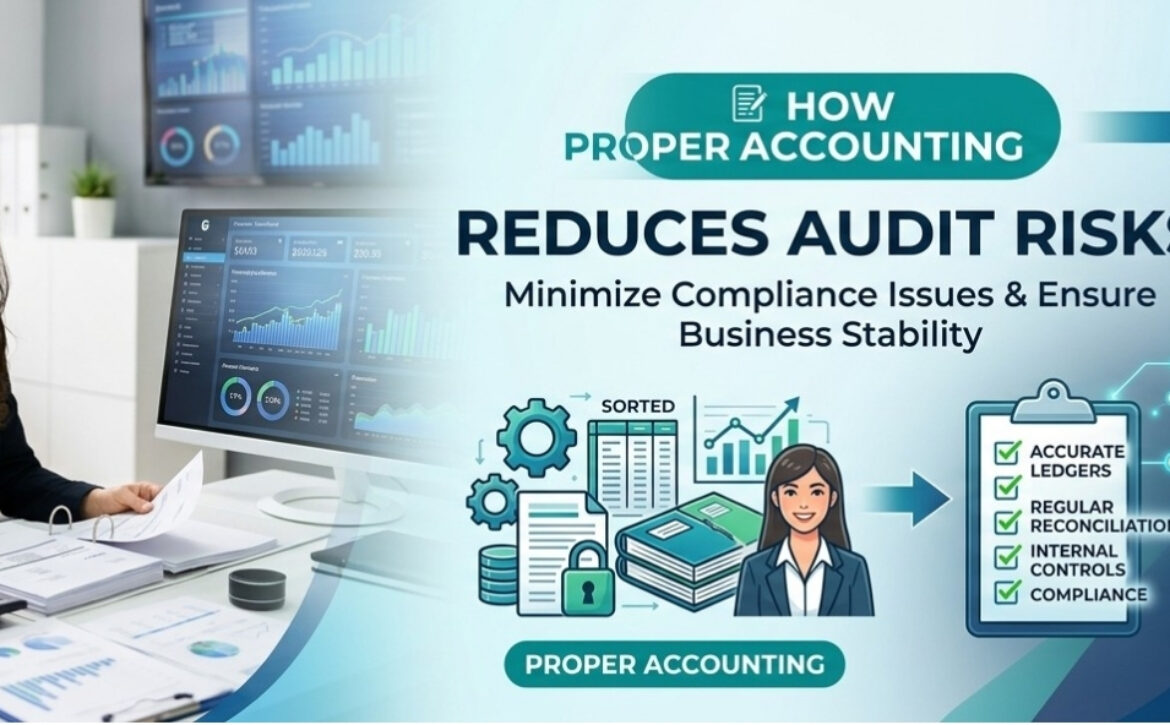
How Proper Accounting Reduces Audit Risks, is a key factor for all modern day businesses. Businesses must always keep track of their financial records. Proper accounting will help to avoid any errors and issues dealing with compliance. Proper accounting will also help to increase a business’s financial transparency and control. Due to the strict regulatory environment and the frequent audits businesses in India must contend with, strong accounting practices are a must for audit risk reduction.

Understanding How Proper Accounting Reduces Audit Risks

All businesses must keep an accurate record of all financial transactions. Through proper accounting, businesses will have a clear, organized way to store and access their complete financial information. When a business has clear records will allow an auditor to verify the information associated with the company. When there are clear records, it will help to eliminate discrepancies and confusion. As a result, the audit process will go quicker and smoother.

Financial accuracy and how proper accounting reduces audit risk

How Proper Accounting Reduces Audit Risks ensures that businesses will consistently have accurate financial information. If there are any errors in the accounting records of a business, it will raise concerns for auditors. If there are accurate accounting records, there will be no need for the auditors to review the company’s financial records for more detail than required because the auditor is getting accurate information that supports the company’s financial accuracy. Through proper accounting, any inconsistencies will be found early in the accounting process.

Also, through proper accounting, the company will produce accurate and reliable financial reports. As a result, the company will be able to significantly reduce its audit risk.

Compliance, and how proper accounting reduces audit risk

How Proper Accounting Reduces Audit Risks, helps businesses comply with federal and/or state and local regulations. Businesses must comply with IRS regulations and the financial reporting rules dictated by the GAAP. Through proper accounting, the company will ensure that tax filings and financial reports are accurate.

Keeping accurate records makes it easier for the business to verify compliance and lessen the potential of being penalized. Because of this, a company is able to keep its reputation in good standing with governing bodies.

The Use of Documentation and How Proper Accounting Reduces Auditing Risks

The ways that proper accounting can help to reduce auditing risk depend upon proper documentation. Businesses need to maintain their invoices, receipts, and accurate financial statements; therefore, having organized records will continue to support audit readiness.

Auditors require clear documentation to perform their work; therefore, having properly maintained records will provide them with the evidence needed to perform an audit with confidence.

Internally Maintaining Controls and How Proper Accounting Reduces Auditing Risk

The reduction of auditing risks through proper accounting is enhanced through strong internal controls. Businesses should have an appropriate system of checks and balances in their financial processes so that their internal control system effectively eliminates errors and fraud.

Regular monitoring of your business’s compliance with procedures improves and enhances the level of accountability among the departments of the business; as a result, a business can effectively reduce its auditing risk.

The Use of Technology and How Proper Accounting Reduces Auditing Risk

Accounting technology has increased the level of risk reduction associated with proper accounting practices. Accounting technologies help businesses automate their financial processes very effectively, and therefore, they reduce their manual errors. Cloud computing provides businesses with real-time access to accurate and up-to-date data. Because of this, the consistency of financial reporting through automation further enhances a business’s overall audit readiness.

Internal Controls and How Proper Accounting Reduces Audit Risks

The role of proper accounting in risk management involves improving the efficiency and effectiveness of businesses’ internal operations. They reduce uncertainties and increase transparency/accountability, creating a more efficient system overall. By identifying issues before they emerge, businesses can take corrective steps to address them early and reduce the likelihood of having significant issues later. As a result, they proactively mitigate risk.

Proper accounting provides several benefits to businesses

It improves financial organization and operational efficiency for a business; hence, the business operates in a much more effective and efficient manner. A business will have an increase in the level of trust with its stakeholders and regulators due to improved accounting practices. Proper accounting assists businesses in making better decisions, hence improving their ability to achieve long-term viability.

How Proper Accounting Can Improve Risk Management through Outsourcing.

Outsourcing the accounting function increases the ability of organizations to effectively reduce audit risk. Professional outsourced services assure accuracy and compliance with laws and regulations. As a result, organizations are able to reduce their workload and, consequently, reduce their audit risk. Professional outsourced services maintain records and ensure compliance with laws and regulations. Additionally, they provide valuable insights into the organization’s financial status.

Outsourcing enhances the accounting function in organizations.

The importance of How Proper Accounting Reduces Audit Risks in an organization’s success cannot be understated. Without accurate records, a business cannot demonstrate compliance with applicable laws and regulations. Therefore, businesses must have strong accounting practices in place.

Businesses that have a strong focus on proper accounting provide the foundation for a successful audit and avoid audit-related challenges. Strong accounting practices will provide businesses with a foundation from which they can grow and maintain stability.

Read More

Tax & Compliance Services in India

Tax & Compliance Services in India

Tax and Compliance Services play an important role in everyday business success. Companies need to abide by various legal and regulatory requirements while at the same time achieving maximum financial benefit through their work. Because of this tax, compliance services provide professional assistance to guide companies through their day-to-day operations without instances of non-compliance.

Avoiding notices or fines from the tax authorities allows a company to continue its operations.

Tax services and compliance services are continually evolving due to changing tax laws, regulations, and reporting requirements; companies must remain informed and take a proactive approach in providing compliance and performing compliance practices.

Why Tax & Compliance Services are Important to a Company

Tax & Compliance Services allow companies to maintain financial discipline and transparency. Companies need to be able to file an accurate tax return, keep accurate tax records, and maintain compliance with their respective regulatory authority in order to show their credibility to both investors and regulators.

Filing accurate tax returns on a timely basis minimizes the exposure to both penalties and audits. Accurate reporting of a company’s financial activity allows it to improve its long-term financial planning and decision-making processes and have long-term sustainable operations.

Types of Tax Services/Compliance Services

Typical tax services/compliance services would encompass many different aspects of a company’s financial activities, such as:

– Income tax
– UK Corporation Tax (UK Corporate Tax Planning/Corporation Tax)
– Goods and Service Tax (GST – GST compliance)/Tax compliance

Consequently, companies that use a tax service firm or a compliance service firm receive help with meeting their obligations to the various authorities.

In addition to providing support in completing regulatory filings, tax compliance professionals also assist their clients in ensuring compliance with relevant regulatory guidelines of government agencies/authorities, as well as industry standards. Therefore, all companies continue to perform their day-to-day activities without disruptions or loss of compliance with various regulatory authorities.

GST Compliance in Tax & Compliance Services in India

Tax and Compliance Services in India include the management of Goods and Services Tax (GST). Under GST, companies are responsible for filing GST returns accurately and on time. Therefore, if your company does not have proper GST compliance, you could face penalties or disruptions in business operations. Tax and compliance professionals can assist you in reconciling your input tax credits and ensure the invoices are in order. They can also help with ensuring that there is the correct classification for all transactions.
By providing this level of assistance, we help you maintain compliance with your GST obligations and to ensure the accuracy of your financial statements.

Corporate Tax Planning & Compliance

Tax & Compliance Services in India can also assist with effective corporate tax planning to enable your company to pay the least amount of taxes while complying with all applicable laws. Through strategic planning, companies can maximize the profitability of their business operations.

Tax professionals analyze your accounting records to develop strategies to minimize your company’s tax liability. They will also verify that you comply with current tax legislation. Consequently, by utilizing these professionals’ advice, your company will reduce the potential for tax audits and improve its financial performance of your company.

Technology’s Impact on Tax & Compliance Services in India

Tax & Compliance Services in India are rapidly adopting new technologies such as digital tools and automated compliance processes. Tax software applications make it easier for businesses to complete their tax calculations and meet their reporting requirements. Therefore, by implementing technology, businesses can streamline their operations and reduce the chance of human error.

Through cloud computing, companies have access to real-time data about the financial position of their business. By automating their tax compliance processes, companies can file taxes in a timely manner and have a sufficient level of supporting documentation for their tax returns. As a result, technology is enabling businesses to better manage their compliance activities.

Outsourcing Tax & Compliance Services in India: Benefits

When Tax and Compliance Services are outsourced to professionals in India, they become more effective. Outsourcing Tax and Compliance Services can help reduce the internal workload and costs associated with a company’s operations, allowing it to devote more time to its core operations.

The professional firms provide expert knowledge and skills related to Tax and Compliance Services. They stay current with changes to the regulatory environment and compliance requirements, improving the accuracy and efficiency of compliance for businesses.

Challenges Associated with Tax & Compliance Services in India

Companies face multiple challenges when providing Tax and Compliance Services in India. Due to the rapid pace of change in regulations, businesses experience challenges in complying due to the complexity created by the frequency of regulatory updates.

Due to the reliance on manual systems, companies have a higher likelihood of making mistakes or experiencing delays. Furthermore, due to a lack of knowledge or expertise, a company may be at risk of non-compliance.
As a result, professional guidance is critical.

Risk Management Through Outsourcing Tax and Compliance Services in India

Tax and Compliance Services support a company’s ability to manage risk by addressing its financial or regulatory risks. By ensuring adequate documentation is available, companies reduce the likelihood of being at audit risk. As a result, companies are able to maintain transparency in their financial reporting.

Regular reviews for compliance will identify issues before they become problematic. Taking corrective action eliminates the possibility of penalties or legal complications. As a result, businesses can operate with confidence.

Tax and compliance services in India are expected to evolve, incorporating technology as well as new legislative requirements. Automated systems for tax compliance and artificial intelligence will improve the compliance process for many businesses by automating some of the work.

As digital reporting systems enhance transparency and efficiency, regulatory frameworks will become more comprehensive. This means that compliance will become more integrated into business strategy.

Future Trends in Tax & Compliance Services in India

Tax and compliance services will be a key driver of sustainable business growth in India, helping to ensure that companies comply with their legal obligations, accurately report their financial performance, and effectively manage risk all of which are critical to success. As a result, companies need to ensure that they prioritize compliance as part of their business operations.

By utilizing professional services to meet their compliance obligations, organizations have the opportunity to increase their overall level of operational efficiency and improve their credibility. Ultimately, businesses that develop strong compliance-related practices will be more successful over the long term in India.

Read More