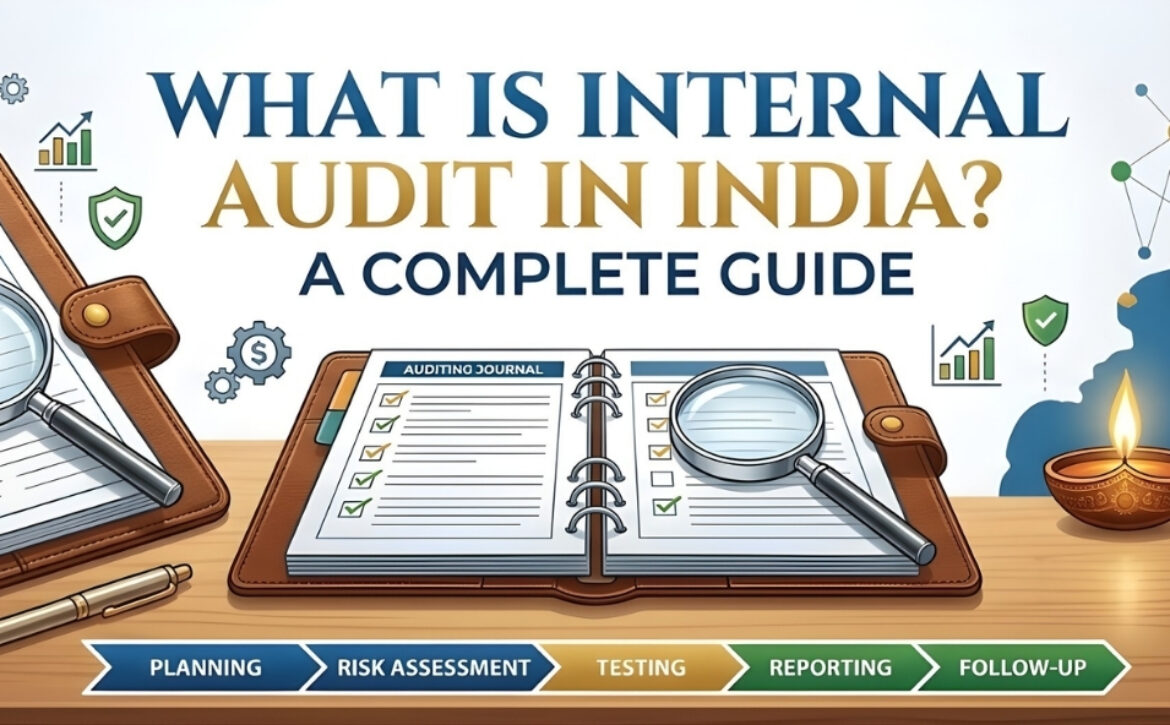
What is Internal Audit in India? A Complete Guide

What is Internal Audit in India? A Complete Guide

What is the Purpose of Internal Audit In India? Giving Insight To Organizations On Financial Control, Compliance With Regulatory Requirements And Monitoring Of Company Risk, Processes, processes, and operations will allow you to ensure that your business is transacting with confidence.

It is critical for companies to regularly assess the risks, processes, and operations of their operations. The effectiveness of having a well-defined internal audit function is to ensure that good business practices are being followed and, therefore, ensure that the organization operates efficiently and effectively.

The ability to make well-informed decisions is an essential part of an organization’s governance process.

Companies in India have significant regulatory burdens placed upon them; as such, a strong internal audit function plays an important role in ensuring compliance and control.

The first thing you will need to know when learning about the internal audit function in India is the definition of the purpose of an internal audit. The internal audit function is responsible for evaluating the internal controls and processes of an organization and conducting periodic reviews of the organization’s financial and operational activities for the purpose of determining whether all aspects of the business are functioning as intended.

The internal audit function identifies areas where an organization can improve its operations through increased efficiency and improved controls, and, as such, an organization is better positioned to maintain an effective governance structure.

Internal Audit (IA) In India: Objectives

As previously mentioned, the key objectives of the internal audit function include:

  • To assist organizations in complying with the laws and regulations that impact their respective business operations.
  • To ensure the organization is aware of the accuracy and completeness of its financial records.

The internal audit department performs a review of the risk management processes in place on a company’s operations, evaluates the adequacy of the internal control system, and evaluates the operational efficiency achieved for the purpose of evaluating the company’s overall performance and accountability.

Advantages of an Internal Audit

There are numerous advantages provided by the Internal Audit in India. For one, it provides improved internal controls and operational efficiency; hence, businesses will reduce their exposure to errors and risk. Additionally, it increases financial transparency and the accuracy of financial reports, as well as improves compliance with regulations. All these things will enable an organisation to achieve sustainable growth.

Technology’s Role in an Internal Audit

The impact of technology on Internal Audit in India. Digital solutions help to streamline the entire process of accounting and auditing, as well as providing greater accuracy and efficiency among auditors. Automation will greatly reduce the number of manual errors arising from an audit. By using advanced data analytics, auditors can quickly and easily identify any patterns or risks that exist within the organisation; thus, maximising the overall effectiveness of the audit.

Challenges

The common challenges that exist when using Internal Audit in India are discussed within it. All businesses are currently faced with a highly complex regulatory environment due to rapid regulatory change, therefore requiring constant vigilance by businesses to ensure compliance. Also, limited resources have an adverse effect on the overall effectiveness of their audit processes. Furthermore, the lack of expertise can result in incomplete audits; thus, professional assistance is essential.

The Guide for Internal Auditors in India provides a clear direction for organizations wishing to improve their internal auditing processes and systems through risk-based and strategic approaches. As companies begin to implement these approaches, they will begin to realize significant benefits from their internal audit function, including the ability to assess and mitigate risk, maximize business efficiencies, and ensure compliance with laws and regulations.

Internal Auditing will continue to evolve with trends such as the increasing use of artificial intelligence and cloud computing, as well as the ability of companies to utilize the Internet to support their business processes. As a result, organizations will begin to focus on using internal auditors to help improve the company’s overall strategic direction and provide a key component of its infrastructure.

The Guide for Internal Auditors in India provides an excellent foundation to help organizations start their internal auditing process and will remain a valuable resource to help organizations continue to successfully implement and maintain effective internal auditing processes and systems.

Read More

The Importance of Bookkeeping for Small Businesses in India

The Importance of Bookkeeping for Small Businesses in India

Bookkeeping is increasingly important to small businesses in India, particularly in the current competitive marketplace. Small businesses must keep track of their financials to continue to operate and grow. Proper bookkeeping provides these businesses with clarity, control over their business, and enables them to make informed decisions. It is also important for compliance purposes and ensuring sustainability over a long time horizon.

The financial landscape for companies in India is ever-evolving. Thus, maintaining accurate and up-to-date financial records is paramount for small businesses to successfully operate.

Understanding the Importance of Bookkeeping for Small Businesses in India

The Importance of Bookkeeping for Small Businesses in India starts with the tracking of financial records as they occur on a daily basis. This allows businesses to develop a good understanding of their overall financial health.

The accuracy of financial records will help business owners make good business decisions. In addition, the accuracy of financial records will increase the accuracy of financial budget preparation and financial planning processes. As a result, the business can operate with greater confidence and control.

Financial Accuracy and the Importance of Bookkeeping for Small Businesses in India

The Importance of Bookkeeping for Small Businesses in India is that it ensures accuracy in the company’s financial records. When a company has incomplete or inaccurate records, the business owner will not have adequate information on which to base his or her business decisions. Errors in record-keeping can result in poor business decisions, which will lead to business losses. Keeping accurate records with consistency from one period to the next reduces the possibility of mistakes and discrepancies.

With accurate financial records, a business can prepare reliable, timely financial reports and have accurate financial records, will be able to assist identifying historical trends in revenue and expenses. Additionally, accurate financial records allow businesses to improve operational efficiencies.

Tax Compliance & Bookkeeping’s Importance to Small Businesses in India

The importance of bookkeeping for small businesses in India is its contribution to tax compliance. Businesses are required to submit the correct GST and income tax returns for both GST and income tax purposes. Therefore, by maintaining accurate bookkeeping, businesses will be able to accurately calculate their taxes owed.

Having organized records will streamline a business’s filing of returns and the documentation required to support those returns. Organized records will also minimize the risk of penalties and legal issues so that companies can continue to remain compliant with the authorities.

Importance of Bookkeeping and Cash Flow Management

The importance of bookkeeping for small businesses in India supports cash flow management. Businesses must routinely monitor the inflow and outflow of cash from their business to maintain liquidity and stability. Therefore, maintaining accurate bookkeeping records will help a business to avoid financial shortages and to make timely payments to suppliers and employees. As a result, the business will not only continue to maintain its cash flow but also maintain financial discipline.

Importance of Bookkeeping and Decision-Making

The importance of bookkeeping for small businesses in India enhances business’ decision-making capability. Business owners make strategic decisions based on their financial data. Therefore, by keeping and maintaining accurate records, a small business will have access to valuable information to consider when making important decisions.

Using financial reports, a business can identify which areas are producing a profit and which areas are costing them money, in addition to assisting them in making pricing decisions and investment decisions. Consequently, the businesses will be able to achieve greater growth results.

Role of Technology in the Importance of Bookkeeping

The growing relevance of Bookkeeping for small businesses in India is established through the increasing automation of bookkeeping processes. Many businesses now use technology that makes the use and management of financial transactions easier, with minimal manual input required. As a result, this technology-based approach to bookkeeping reduces the number of errors made in bookkeeping and increases the efficiency of completing bookkeeping activities.

Cloud computing has provided new ways for businesses to track their financial performance. Innovations in finance software continue to drive increased accuracy and speed in reporting. Therefore, technology continues to improve and enhance overall financial management.

Risk Reduction and the Importance of Bookkeeping

The Importance of Bookkeeping for Small Businesses in India also helps lower the risk of financial failure. The risks associated with record-keeping include opportunities for fraud and poor management of the company’s funds. By having accurate record-keeping systems in place, the Company can achieve a higher level of transparency and accountability.

Reviewing records regularly will assist in identifying and minimising anomalies early. Strengthening internal controls allows a Company to better safeguard its assets.

Business Growth and the Importance of Bookkeeping

The Importance of Bookkeeping for Small Businesses in India ultimately supports the long-term growth of the Company. Businesses with accurate and consistent financial records are in a better position to have a well-defined strategy to support their expansion. As a result, companies can optimise their use of available resources.

Accurate financial statements are essential for businesses attempting to obtain financing from lenders or equity sources. Good and sound record-keeping enables a Company to improve its credibility and enhance its ability to obtain financing. As a result, by having good financial records, a Company is better positioned to expand its operations successfully.

Outsourcing Bookkeeping and How it Benefits Indian Small Business Owners

For small businesses in India, Outsourced Bookkeeping Service Providers offer them Professional Assistance for Simplifying Operations (i.e., reducing the Workload). As a Result, The Business Can Put Its Focus Back on Its Core Business. Outsourced Bookkeeping Professional Services Will Also Provide Businesses with the necessary financial compliance experience and Accuracy with Rules and regulations, and All The Information You Need to Understand How to Improve Your Operations Financially. They Will Increase Their Reliability By Providing Greater Operational Efficiency Through Their Professional Expertise.

As a Business Owner, You Should Not Underestimate the Value of Maintaining Accurate Bookkeeping Records, Especially In Today’s Business Environment, Since Accurately maintaining Your Books Is Essential for Ensuring Compliance, Control Over Your Finances as Well as Developing Great Business Plans for Future Growth. All Businesses Should be Dedicating Time and Resources to establishing strong bookkeeping records.

When Businesses Do a Good Job of Maintaining Accurate Bookkeeping Records, They Have a Much Greater Ability to Achieve Long-Term Business Stability And Success for the Future. A Business’s Bookkeeping Records Create the Foundation for Business Growth.

Read More

Risk Management for Expanding Businesses in Dubai

Risk Management for Expanding Businesses in Dubai

Risk Management for Expanding Businesses in Dubai ensures stable and sustainable growth in Dubai. While there are opportunities to be gained through expansion, there are also substantial operational and financial risks. Therefore, appropriately establishing structured risk management frameworks at an early stage is critical for companies to succeed. Proactive planning will also protect the investment and enhance the resilience of the business for the long term.

To expand within the United Arab Emirates, businesses need to demonstrate compliance, financial discipline, and governance. As a result, businesses must identify potential risks before scaling their operations.

Understanding Risk Management

Risk Management for Expanding Companies in Dubai starts with a thorough identification of all risks involved. Companies need to carefully assess their operational, financial, and regulatory exposures. Therefore, conducting structured risk assessments will assist companies in making more informed decisions regarding expansion.

Regulatory changes and volatile markets can introduce uncertainty and create the possibility that new partnerships will bring with them unknown liabilities. Therefore, businesses must adopt a proactive approach to monitor for risks.

Financial Risk

The provision of sound financial management is a key component in understanding the risk factors associated with expanding businesses. With expansion, the level of capital spending and the ongoing operational costs are typically increased. Therefore, companies must closely monitor both their budget and their cash flow.

By incorporating regular flow forecasting, companies can avoid liquidity problems as they expand their business. Additionally, conducting regular reviews of financial statements will allow companies to identify and rectify cost inefficiencies sooner, thus improving stability while expanding their business.

Compliance with Regulations and Risk Management for Expanding Businesses in Dubai

Compliance with Regulations and Risk Management for Expanding Businesses in Dubai involves adherence to strict regulations. Businesses must meet accurate licensing and reporting to comply with all applicable laws. Therefore, compliance systems must facilitate transparent operation.

Regulatory Authorities require the submission of accurate records on time. Any non-compliance by the business may result in financial penalties or disruption to the business operation. Consequently, businesses are required to conduct ongoing regulatory compliance monitoring.

Operational Risks as Part of Risk Management within Expanding Businesses in Dubai

It considers the complexities of operations. As new businesses expand, they must add new processes, people, and reliance on their supply chain partners. Therefore, businesses need to standardize their processes throughout their entire operation.

Documenting business processes improves consistency and accountability throughout the business. By measuring operational performance, a business can identify operational inefficiencies quickly where they occur. Thus, businesses can maintain quality throughout the expansion process.

Strategic Risk: Risk Management for Expanding Businesses in Dubai

Risk Management for Expanding Businesses in Dubai involves using a methodical strategy when making expansion plans. Companies need to base their expansion goals on the reality of the marketplace. Thus, it is necessary to conduct market research before making investment decisions. Competitor analysis will help with establishing a strategic position in the marketplace. Scenario planning allows businesses to be prepared for unforeseen events. This helps to reduce uncertainty and provide improved results.

Technology Risk: Risk Management for Expanding Businesses in Dubai

Risk Management for Expanding Businesses in Dubai involves evaluating the infrastructure of their technology systems. When expanding a business, new technology platforms and systems are usually necessary. Therefore, businesses must evaluate their cybersecurity capabilities, as well as their ability to provide reliable systems. The protection of data is critical to preserving financial and operational information. Automation of manual processes can eliminate errors and increase efficiency. Therefore, the integration of technology will help businesses improve their risk control framework.

Human Resources Risk

Risk Management for Expanding Businesses in Dubai requires businesses to effectively manage their human resources. As companies grow, they will have an increasing need for new hires and have a more complex organizational structure. As such, it will be imperative for businesses to recruit skilled employees and ensure that their employees are compliant with all company policies.

By creating training programs for their employees, an organization can increase productivity and minimize mistakes. Furthermore, having clear policies can enhance accountability and encourage ethical behavior within an organization. Ultimately, well-structured teams can foster stable, controlled growth for a business.

Internal Controls

Businesses expanding in Dubai rely on strong internal controls for risk management, including segregating duties to reduce the risks of fraud and errors, approving and reviewing processes, performing regular audits for compliance and effective operations, and using internal reporting systems to increase transparency and oversight to maintain governance throughout the expansion process.

In addition, businesses must continually monitor and evaluate risk management as their business environment will change as they expand operations. Therefore, businesses should frequently review their risk framework or processes. Monthly or quarterly performance metrics can help identify vulnerabilities; however, only by having a structured management review process can management take corrective action in a timely manner. This will enable businesses to adapt to changing conditions effectively.

Risk Monitoring and Review Processes

In addition, businesses in Dubai that are preparing to expand their operations will benefit from professional advisors. Professional advisors can help a business understand regulatory, financial, and operational obligations; therefore, businesses can develop a strategic path for the organization to make complex decisions.

External auditors will provide a business with an independent risk assessment as well as provide the business with guidance on compliance and governance issues, which will help strengthen the business’s expansion strategies.

The Value of Long-Term Risk Management for Dubai Businesses is Growing

The use of Risk Management for Growing Dubai Businesses promotes sustainable and well-regulated growth. Risk Management creates a structured framework for the protection of its assets and to make sound business decisions. Corporations can maintain stability while the market fluctuates.

Also, effective Risk Management helps to build trust with Investors and Stakeholders as well as improve corporate reputation and credibility. Ultimately, disciplined use of Risk Management will help lead to long-term success.

Risk Management for Developing Dubai Businesses continues to be an important component of scalable and secure growth. Organizations should be proactive in addressing their financial, operational, and regulatory risk. Having structured frameworks results in maintaining stability and resilience.

Companies that focus on Risk Management will attain a higher success rate for their growth initiative. Ultimately, preparation and governance are critical for sustainable growth in Dubai.

Read More

Strategic UAE Internal Audits

Why Internal Audits Are Becoming a Strategic Tool for UAE Businesses

As the business landscape evolves rapidly, organizations in the United Arab Emirates (UAE) must contend with changing rules and regulations, digital transformation, and international competition. As a result, many organizations have considered changing their approach to risk management and compliance. This is where Strategic UAE Internal Audits have a significant role to play. Organizations are no longer viewing internal audits strictly as a regulatory requirement, but rather viewing them as a method of driving efficiencies, protecting assets, and creating long-term resilience.

From Compliance to Strategic UAE Internal Audits

Audits were traditionally viewed as simply ensuring that the organization was following the laws and industry regulations. However, the business landscape in the UAE is changing. With the drive for reporting transparency, corporate governance, and digital innovation, organizations are now realizing that internal audits can be a strategic tool for businesses in the UAE. Not only do they identify risks, but they can also provide actionable insights that support decision-making and long-term growth.

For example, today’s internal auditors are playing a proactive role by not only identifying gaps in operational processes and fraud, but also recommending improvements in resource utilization. This puts internal auditing in the role of a partner in growth rather than the role of a watchdog.Strategic UAE Internal Audits

Establishing Trust and Transparency

A primary concern for businesses in the UAE is sustaining trust with various stakeholders, such as investors, regulators, and customers. Internal audits can assure the reliability of financial reporting, risk management, and governance, and therefore, internal audits can become a strategic tool for businesses in the UAE to attract investors or to grow globally.

A solid internal audit structure creates confidence with stakeholders, indicating that the business is not only compliant but also focuses on best-practice governance and transparency. All of this is critical for trust in certain markets such as the UAE, which is positioning itself to be a global trade and investment hub.

Improving Operational Efficiency

A reason that internal audits are rapidly becoming a strategic tool for UAE businesses is the potential for them to identify inefficiencies and suggest improvements. In many entities, these inefficiencies may fester for years, leading to wasted resources and missed opportunities. Internal audits offer a process for identifying redundant processes, streamlining processes, and better allocating resources.

For example, an internal audit may identify capabilities that are “gathering dust” because they are underutilized, or the audit may identify that two departments are duplicating efforts with the same work tasks. Addressing issues identified during internal audits will allow businesses to lower costs and improve productivity.

Promoting Digital Transformation

The UAE is leading the world in the adoption of innovative technologies, like AI, blockchain, and cloud computing. At the same time, rapid digital transformation also creates risks, including cybersecurity threats, data privacy issues, and system weaknesses. Again, internal audit can serve as a strategic tool for businesses in the UAE.

They now focus not only on assessing financial and operational risks but also on governance risks associated with IT and cyber. They make sure businesses take data protection seriously, keep systems resilient, and follow international best practices. As UAE businesses embrace digital transformation, internal auditors continue to guard and strengthen those initiatives.

Planning for the Future Strategic UAE Internal Audits

The global economy is unpredictable, and businesses in the UAE must plan for sudden upheavals, be it an economic downturn, regulatory changes, or global supply chain issues, to name a few. Internal audit can provide foresight to help plan for the unknown—this is why internal audit is fast becoming a strategic tool for those UAE businesses who wish to remain relevant in the longer term and continue to be resilient.Strategic UAE Internal Audits

Through early risk identification, enhanced controls, and alignment with strategic objectives, internal auditors provide organizations with the nimbleness to respond to future problems in a timely and effective manner. Internal auditing is not just about catching problems after they have occurred; it is about creating organizations that excel in a constant state of change.

The role of internal auditing has shifted dramatically across the UAE. Internal auditors are no longer simply compliance checkers or identifying errors ex-post; they are now impacting strategic business decisions, finding and enhancing efficiencies, and supporting the economy to grow in a changing landscape.

Read More

Business Valuation in Dubai

Business Valuation in Dubai: Key Considerations for Mergers and Acquisitions

In the constantly evolving business environment we operate in today, it is essential to know the real value of a company to make the right decision. Valuation is significant in all sorts of situations, whether you are preparing for a merger or acquisition, an investment round, or developing a succession plan. In the case of businesses in the UAE, Dubai Business Valuation has become more prevalent due to market growth, regulatory reforms, and recent international investor interest.

This blog is designed to explore the reasons for business valuation, valuation methods, and how professional advisors ensure returns that are accurate. Business Valuation in Dubai

Reasons Dubai Company Valuation is Important

The UAE, and Dubai in particular, is the world’s hub for trade, finance, and entrepreneurship. With businesses in real estate, retail, technology, and logistics (to name a few), businesses need to understand their business value.

Some examples that businesses need a Dubai Business Valuation include:

  • Mergers and Acquisitions (M&A): Competently constructed valuation enables partners to avoid disputes regarding valuations and build an agreed-upon deal structure.
  • Investment Discussions: Interested parties’ investment in a business requires a considered basis (credible) around financial insights.
  • Succession Planning: Family or private businesses require, valuation for future wealth transfer.
  • Dispute Settlement: Shareholder conflicts can be settled by establishing the true value of the company.
  • Compliance: Documenting reliable value for taxation or audit.

An absence of a structured business valuation process has a risk of undervaluation, misallocated opportunities, or settlementitisually resulting in litigation based on value.

Methods for Valuation of Business Activity in Dubai

Professional Firms in Dubai utilize credible valuation techniques that are accepted worldwide. The method chosen may depend on the type of business, financial viability, industry, and market position.

1. Asset-Based Valuation-  Valuation that focuses on obtaining a net asset value after recourse to liabilities. Generally is the method is used for entities with material tangible assets.

2. Income Valuation- The valuation is income-based and is premised on calculating future cash flow based on profitability. Typically best for valuable or growing businesses.

3. Market Valuation- Market-based valuation compares the business and how it compares to other businesses of the same type and market. Works well if it is a competitive market.

Regardless of the method used, Dubai Valuation will continue to be conducted in an accurate manner and in accordance with internationally acceptable market practices.

Dubai Business Valuation in M&A

In Dubai, mergers and acquisitions are on the rise, due in part to the continually increasing cross-border investment activity. Performing a proper valuation allows the buyer and seller to settle on a mutually agreeable price. The valuation will often result in lower channel risk for both parties in the transaction.Business Valuation in Dubai

For example:

The buyer will feel more secure in acquiring a company; the seller or current owner will feel they need not undervalue their tangible or intangible business assets, while a third-party investor will rely on the valuation when calculating the potential for the ROI in investing. Ultimately, once most of the negotiations are undertaken by their respective experts, the buyers and sellers can comply and transact business more smoothly and with better transparency, resulting in better chances for expediting the transaction and possible future partnerships.

The Role of Professional Advisors in a Business Valuation

The financial statement provides a good source of information to begin with, and the valuation is considerably more intricate. Worth is also influenced by factors including brand reputation, intellectual property, market positioning, and customer loyalty.

Professional advisors add value in:

  • Analysing both tangible and intangible assets;
  • Introducing tax and regulatory considerations;
  • Providing an independent and unbiased report;
  • Using sophisticated financial modelling tools;

When choosing a firm for valuation, an experienced advisor will have the requisite credibility, which is essential, particularly in cases of legal obligations, regulatory requirements or as part of an investment requirement.

The Challenge of Dubai Business Valuation

Dubai, while having a thriving business environment, has numerous challenges that make evaluating a corporation difficult:

  • Market Fragility: A company’s worth can change quickly based on oil prices, shifting global trade, and/or geopolitical events.
  • Sector Polarity: The techniques of valuing real estate, tech drivers, or logistics often differ considerably;
  • Regulatory Considerations: The arrival of corporate tax and compliance changes has impacted valuations.
  • Intangible Assessments: Measuring and managing brand equity and goodwill is incredibly complicated yet also very valuable.

Therefore, understanding these challenges requires a local knowledge base but must be consistent with international principles. This is one of the reasons why Dubai Business Valuation services provided by business valuation firms are so relevant.Business Valuation in Dubai

The Future of Dubai Business Valuation

As Dubai continues to attract funds from all corners of the globe and positions itself as an innovative business hub, evolving practices in business valuation will develop further. This includes the adoption of digital change, ESG (Environmental, Social, and Governance) reporting techniques, and artificial intelligence approaches to financial modelling.

Forward-thinking businesses that regularly engage in valuation will always find themselves in a better position to attract investors, obtain financing, and execute growth strategies. Dubai Business Valuation is not simply a financial exercise, but rather a strategic tool for sustainable success.

​The Importance of Knowing Your Value

Business valuation is much more than some numbers—it is about how owners can understand their business’s strengths, weaknesses, risks, and opportunities to identify value drivers. The business valuation process provides a near-absolute precursor to managing growth, partnerships, and legacy for Dubai-based businesses.

Whether it is mergers and acquisitions, succession planning, or preparing for investment, Dubai Business Valuation is a necessity. Defining business valuations in the Dubai market by objective advisors will create transparency, fairness, and future thinking in one of the world’s most competitive investment markets.


Read More

Guard your future with a personal wealth guide

Guard your future with a personal wealth guide

Handling money has always been a valuable life skill; however, in today’s world, where both personal finances and the global economy are undergoing rapid transition, building and safeguarding personal wealth is more important than ever. Whether you are a professional, entrepreneur, or family-oriented individual, creating a method to your financial decisions can transform your lifestyle and security in the long run. This is also why you need to guard your future with a Personal Wealth Guide – to provide clarity, direction, and actionable steps towards growing your wealth in an enduring way.

Why do you need a Personal Wealth Guide?

Most people think of wealth as simply making more money; however, one’s definition of wealth determines their path to it. True wealth is making better use of their money. If there is no structure to your financial planning, you run into issues like:

  • Difficulty controlling your savings and expenses.
  • Investing in no systematic method.
  • Not thinking about estate planning and your long-range retirement data needs.
  • Mixing up your wealth from families vs. your business.
  • Confusion between the tax implications of evolving regulations.

Not only can you feel all of these pressures when you do not have a financial plan, but A Personal Wealth Guide can provide a road map that links all of your financial decisions to your lifestyle objectives. If you begin with a method to succeed and a budget to support it, most of the money problems you have been encountering were actually ‘money’ problems you haven’t factored in.

The base layer of Guide.                                                                                                                                               

A comprehensive wealth strategy starts with a sound financial foundation. Before you ever consider investments, estate planning, or tax efficiency, it is important to get the fundamentals right:

  • Smart Budgeting – Have a realistic budget that accounts for both needs, wants, and savings so as to avoid a situation where your income increases but savings stay the same, also known as lifestyle inflation.
  • Emergency Fund – Experts advise having at least 6 months of expenses saved for unforeseen circumstances.
  • Manage Debt – Not all debt is bad, but bad debt (with high interest) can create a roadblock by eroding potential wealth-building opportunities. Consolidate and/or eliminate bad debt.
  • Insurance and Other Risk Management Strategies – Make sure to insure yourself, your property, and your family to make sure unexpected risks do not erode your wealth. 

These fundamentals are the first layer of your Personal Wealth Guide. It is important to be financially grounded before you move into more sophisticated strategies. 

Personal Wealth Guide: Asset Allocation

Investment strategies are an integral part of wealth building. However, it is common for people on both ends of the spectrum to either under-invest for fear of risk or excessively invest hastily when times are good, and only to end up regretting their decisions after significant losses. You must find balance. 

Diversification – Investments must be diversified across asset classes:  real estate, stocks, bonds, mutual funds, and alternative investments. Estate & Succession Planning with a Personal Wealth Guide. Estate planning is one of the most passive areas of wealth planning that tends to be ignored. There is a large number of expatriates and high-net-worth individuals residing in Dubai and worldwide who plan to fail when it comes to transferring wealth. This leads to unnecessary frustration and pressure on family members later.

Included as part of the personal wealth guide is

  • The drafting of wills in accordance with local laws,
  • Establishment of trusts to protect family wealth,
  • Succession planning for business owners so that personal wealth can be separated from business wealth,
  • Arranging for the seamless transfer of property and money globally.
  • Estate planning will allow your wealth to last for generations beyond your lifetime!
  • Retirement Planning in Personal Wealth Guide

Guard your future with a personal wealth guide


With some countries offering little or no formal pension plans – and without mandatory pensions, the retirement planning process must be taken seriously. Guard your future with a proper  personal wealth guide that supports a retirement planning process, including:

1. Identifying when you want to retire and the type of lifestyle you want to lead in retirement,

2. Establishing a savings and investment plan to replace income after you no longer work,

3. Taking into account inflation, potential healthcare costs, and age/ longevity, and;

4. Striking a balance between security and enjoying your present lifestyle.

By planning early, you can retire without sacrificing too much of your current standard of living.

Lifestyle Finance & Personal Wealth Guide

Wealth is not just about saving—it’s about living well today while securing tomorrow. A practical way to guard your future with a Personal Wealth Guide emphasizes lifestyle finance, which includes:

  • Planning for the education costs of children.
  • Purchasing property at the right time.
  • Avoiding lifestyle inflation when income rises.
  • Allocating funds for travel, hobbies, and experiences without guilt.

This balance between lifestyle and long-term security is what makes personal wealth sustainable.

Real-Life Examples 

1. Professional Retirement – A senior executive built a diversified portfolio with the help of a financial expert, ensuring retirement in 15 years without compromising their current lifestyle.

2. Entrepreneurial Wealth Planning – A business owner separated personal and business assets, created a succession plan, and ensured tax compliance across borders.

3. Global Investor Tax Structuring – An expatriate investor used smart planning to avoid double taxation and remain compliant with international reporting laws.

These cases show how applying a Personal Wealth Guide transforms challenges into opportunities.

Benefits of Following a Wealth Guide

By engaging in structured wealth planning, individuals gain:

  • Clarity & Control – Knowing exactly how money supports lifestyle goals.
  • Reduced Risk – Avoiding unexpected liabilities and unprotected wealth.
  • Peace of Mind – Confidence in family security, estate planning, and retirement.
  • Sustainable Growth – Wealth grows wisely without lifestyle compromises.
  • Global Compliance – Protection against penalties and legal issues.

A Personal Wealth Guide is not a luxury—it’s a necessity for anyone who wants to live confidently today while protecting tomorrow.           


Why Now is the Best Time for Guide?

The time to plan your wealth is now. With changing global economic conditions, evolving tax laws, and new lifestyle choices, putting off wealth planning can be risky. Dubai and other major financial centres are changing fast, and now is the time to act proactively. When you take action, you build a stronger financial foundation. The best time to create your Personal Wealth Guide is now—not later! Whether you are a career professional, entrepreneur, or builder of a family, guarding your future with a Personal Wealth Guide will better serve you now.

Wealth is not simply about the financial balance sheet. Wealth is about living the life you want with confidence, security, and sustainability. A Personal Wealth Guide will see you align your financial strategies with your lifestyle desires, no longer diverting your attention away from your goals as you seek to balance living today with preparing for tomorrow.

In proactive planning, you:

  • Find Financial Freedom.
  • Protect wealth through boundaries and generations.
  • Develop a lifestyle aligned with your dreams.

At the end of the day, a Personal Wealth Guide is never simply about the numbers. It is about empowerment. Empowering you to live your best life with financial clarity and confidence.                                                                                                                                                                                                                                                                                                

Read More

Business Setup in UAE

The United Arab Emirates (UAE) is now a magnet for businesspeople and investors from around the world. This is because of the country’s advantageous business location, high-quality infrastructure, business-friendly policies, and tax benefits, all of which strongly attract startups and established global companies. However, despite the vast opportunities, launching a business in the UAE demands meticulous planning, adherence, and a thorough grasp of the legal and financial frameworks. As a consequence, Business Setup in the UAE is now one of the most sought-after and discussed topics for budding businesspeople and investors.

Business Setup in UAE

Reasons to Undertake Business Setup in The UAE

The UAE stands a step above the rest due to the following reasons, which bring in businesses from all corners of the world:

  • Tax Advantages: Personal income tax is 0% in the UAE, and corporate tax policies are business-friendly, minimizing the burden of taxes for companies.
  • Free Zones: Across the UAE, free zones provide 100% foreign ownership, simplified business licensing, and customs benefits.
  • Location: The UAE’s location bridges the gaps between Asia, Africa, Europe, and other regions.
  • Conducting Business: Cellular invasive diseases, marketing government strategic policies with earlier and modernized initiatives, alongside businesses, increase the ease of starting and operating a business.
  • UAE, alongside other countries: The innovation, trust, and safety standards of international investors in the UAE are well-known globally.

Setting up a business in the UAE is a strategic move owing to the innovative trust of investors in the region; it spans the healthcare, logistics, retail, technology, and finance sectors.

Options for Business Setup in the UAE

In the UAE, for company formation, here are the primary structures that can be opted for:

1. Mainland Company

  • Works best for companies serving the local UAE customer base.
  • Needs approval and licensing from the Department of Economic Development (DED).
  • Enables trade locally within the UAE and internationally.
  • May require additional permits for some activities.

 2. Free Zone Company

  • It would provide 100% foreign ownership, and so would the return of profits.
  • It would be of interest to overseas companies, not requiring much engagement with the UAE mainland.
  • Provides zones for specific industries such as Dubai Internet City, Abu Dhabi Global Market, Sharjah Media City, and many more.
  • Reduced Tax and Customs Advantages

3. Offshore Company

  • Generally, for international commerce, safeguarding investments or holding companies.
  • Offers privacy protection, tax advantages, and fewer compliance formalities.
  • Direct trading within the UAE is prohibited.

All these alternatives have their own set of rules, licensing, and financial implications. Selecting the correct entity is an important part of Business Setup in the UAE.

Business Setup in UAE


Business Setup in UAE: Procedures

For a hassle-free experience, business owners must take the following actions:

  • Identify Business Activity – Details the particular business sector and the activity planned to select the relevant commercial, professional, or industrial licence category.
  • Decide the Legal Structure – Select between registration as a sole proprietorship, partnership, LLC, branch office, or holding company.
  • Pick the Location – Choose either the mainland, free zone, or offshore based on the business goals.
  • Reserve Trade Name – Decide on a distinctive company name that complies with the regulations.
  • Gather Required Materials – Copies of passports, Memorandum of Association (MoA), shareholder agreements, and relevant feasibility studies.
  • Submit for Business Licence – Apply for trade, professional, or industrial.
  • Open Corporate Bank Account – A Bank Account is essential for operation, salary payments, and compliance.
  • Registering for VAT/Corporate Tax – Depending on your turnover and the nature of your company, you will need to register for VAT/Corporate Tax with the Federal Tax Authority (FTA).
  • Set up Bookkeeping & Audit Systems – It is essential that Businesses implement effective bookkeeping and audit systems within their Business, to protect themselves and comply with UAE regulations, and also to provide a good basis for reporting.

Going through the above tasks in an orderly manner will ensure Business Setup is efficient with minimal delays and reduce any compliance risk or concern.

Common Issues Setting Up a Business in the UAE

The UAE is a great destination for businesses. However, many entrepreneurs experience issues and outcomes when they have not engaged with the correct level of preparation in the business set-up stages. Common mistakes Entrepreneurs have made when setting up their business include:

  • Selecting the wrong structure (mainland, free zone, or offshore) could have implications for your growth or cost.
  • All too often, Entrepreneurs do not confirm the licensing requirements and then waste time on the application process.
  • Asking for a fish out of the water, non-compliance with VAT, corporate taxes, or whatever penalties.
  • Entrepreneurs stop once they manage to get documents and approvals, and have a long compulsory delay.
  • Limited financial planning can lead to cash flow issues in the early stages of business.

If you are serious about a Business Set-up in the UAE, these issues must be considered. Engagement and proper planning with good professional advice will certainly help to reduce unnecessary headaches in the process.

Business Setup in UAE

Key Industries Booming in the UAE

The UAE’s diversified economy presents a wealth of opportunities in a variety of sectors. Some of the fields where new businesses are particularly popular include:

  • Technology & IT Services – buoyed by innovation and government-led digital transformation.
  • Healthcare & Wellness – explosive growth attributed to growing demand and medical tourism.
  • Logistics & Trade – bolstered by the UAE’s ports and airports and a central position in global trade.
  • E-Commerce & Retail – spurred by shifting consumer behavior and the large internet penetration in the country.
  • Financial Services & FinTech – supported by welcoming regulations and a desirable destination for global investors.

These industries are active examples of the opportunities and options for entrepreneurs planning their Business Setup in the UAE.

Benefits of a Business Setup in the UAE

When properly done, a company formation in the UAE can yield benefits for many years into the future:

  •  Access to Regional & Global Markets
  •  Tax Efficiency & Consistent Cost Savings
  •  Improved Brand Image & Credibility
  •  Political & Economic stability
  •  Investment-Friendly Ecosystem & Talent

A business in the UAE is not just a company incorporation; it is the start of a properly planned, sustainable growth for you, your business, stakeholders, and any market you may go to!

Looking Ahead

The UAE is still dynamically adapting and establishing itself as a global centre for entrepreneurship – supported by many positive initiatives (such as Expo 2020 legacy projects and ongoing change associated with the consolidation of Vision 2030, and a much stronger focus on sustainability and digital transformation). The UAE must continue to evolve to compete; expect to see continuing wealth creation opportunities and significant economic diversification. Those businesses that set up now will certainly be first movers in many key growth sectors in the coming years.

The UAE is much more than a place to do business; it is a place to connect and access global markets. The task of setting up a company in the UAE is more complex than just incorporating and includes consideration of various business structures, licensing, compliance, and financial regulations. By gaining an understanding of what is needed to set up, what challenges and opportunities exist, business owners will feel confident about proceeding with Business Setup in the UAE.

In a rapidly changing business environment, making informed choices when setting up reinforces individual opportunity management and ownership for the future. The UAE represents one of the most rewarding business setup options for Investors, start-ups, and Established companies. Enjoy the journey of Business Setup in the UAE.

Read More

From Startup to Scale-Up: Business Advisory by CAs in Dubai Unpacked

Business Advisory & Management Consulting in Dubai: How CAs Drive Growth

In Dubai’s competitive market, where innovation meets regulation, turning an idea into a thriving business requires more than just ambition. Entrepreneurs often struggle with structuring their ventures, managing finances, or scaling sustainably. That’s where Chartered Accountants (CAs) play a pivotal role.

Business Advisory & Management Consulting in Dubai: How CAs Drive Growth explores how CAs serve as strategic advisors, helping businesses from the early startup phase to expansive growth.


Navigating the Startup Scene in Dubai

Dubai provides fertile ground for entrepreneurs with its free zones, low taxes, and 100% foreign ownership opportunities. However, a startup still faces critical challenges: navigating legal frameworks, planning finances, and managing compliance. CAs offer essential business advisory services that turn chaos into clarity.

Business Advisory & Management Consulting in Dubai: How CAs Drive Growth is more than a headline — it’s a strategic approach. CAs guide founders on choosing between free zone and mainland setups, ensure VAT and ESR compliance, and build strong financial foundations.


Core Services – The Growth Engine Provided by CAs

CAs are not just accountants – they are business architects. Their knowledge allows entrepreneurs to increase the level of decision-making capability on a variety of fronts:

  • Business Structuring and legal compliance: Advice on licensing and ownership models, regulatory filings
  • Financial forecasting and budgeting: Data-driven cash flow planning and budgeting to avoid financial distress
  • Investor-ready and valuations: Generate credible reports and valuations to involve an appropriate number of VCs and angel investors
  • Internal controls and risk management: Design the systems to prevent fraud and inefficiencies in operations
  • Tax – Corporate tax and VAT advisory: achieving optimal compliance that reduces exposure and avoids penalties

Growth of businesses requires growing complexity, and businesses require CAs to step in as management consultants that provide businesses with specific strategies for growth. In the past, CAs would simply be accountants or financial advisors, but no,w as CAs have expanded their offering into management consulting and advisory, they can:

Understand the cost structure and work out the profit drivers
Advise on ERP systems and other tools to drive efficiencies and support operations
Provide KPIs and dashboards allowing management to make informed decisions based on data
Guide businesses looking to plan for regional growth, including advice on regulatory requirements for DIFC or ADGM.

Business Advisory and Management Consultancy in Dubai: How CAs are driving growth is going to become more relevant, as businesses are not simply working to stay compliant, as the organisations look to round out and scale their business smartly.

The Local Edge: Benefits of Dubai-Based CAs

Dubai’s regulatory and market context is unique. A local CA has specific knowledge of:

  • Free zone versus mainland benefits;
  • Cross-border tax considerations in the GCC;
  • Labour and immigration compliance.

Their advice incorporates global accounting standards with regional knowledge, so that you can make strategically sound and compliant decisions.

Success Snapshot: Founding Seed to Series A

One health tech start-up based out of Dubai was having difficulty in moving to its next funding round. With the help of a CA, the start-up restructured its cap table, streamlined its expenses and set up a compliant payroll for tax. Within just over a year, they had secured a Series A round and expanded into three countries.

The phrase Business Advisory & Management Consulting in Dubai: How CAs drive Growth is not a theoretical statement — it’s a demonstrated success framework.

Read More

Top Compliance Services in Dubai Every Business Needs

Top Compliance Services in Dubai Every Business Needs

Dubai is considered a global hub of business activity, home to startups, SME’s and multinational enterprises—all drawn to the region’s progressive regulatory environment and tax policies. Where there is opportunity, there is responsibility and thus compliance. Slick & Sharp provides the top compliance services in Dubai that every business should know about so you can continue operating legally, hitting operational milestones, and managing a reputable business.

Why Compliance Is Crucial in Dubai

The UAE authorities continue to be active in regulating corporate entities to enhance corporate transparency, anti-money laundering (AML) activity, data privacy, and general tax compliance. Companies that are not compliant are exposing their business to a range of consequences, including but not limited to penalties, disruptions to business operations, and reputational harm. Engaging the best compliance services in Dubai that all businesses should know about will assist organizations in fulfilling their legal obligations and other requirements in a risk-managed, timely, and cost-effective manner.

Essential Compliance Services for Dubai Businesses

1. Corporate Governance Advisory

Proper governance keeps businesses in an ethical framework while remaining legally compliant. At Slick & Sharp, we have experts to develop internal frameworks that ensure businesses promote accountability and adherence to the UAE corporate codes. 

2. AML & CFT Compliance

Anti-money laundering laws are an important obligation for all businesses, so they must conduct proper due diligence and reporting. Our experts ensure the processes and transactions fully comply with AML/CFT, and it’s one of the top compliance services in Dubai that every business should know.

3. Economic Substance Regulation (ESR)

Companies engaged in specific activities must show they have substantial operations in the UAE. We assist our clients with determining the applicability of ESR, submitting notifications, and maintaining appropriate documentation.

4. Ultimate Beneficial Ownership (UBO) Reporting

Where there is no appropriate documentation, UBO and ultimate beneficial ownership will be difficult to ascertain. Maintaining accurate UBO records on entity ownership will help identify actual ownership structures. Our consultants will manage our clients’ UBO files and disclosures so that they do not face fines or regulatory scrutiny for non-compliance.

5. VAT and Tax Filing Compliance

Any errors in tax reports have the potential to result in penalties or examinations. We take care of any VAT returns and corporate compliance filing due dates to ensure that our client is fully compliant with regulations. This is one of the top compliance services in Dubai that every business needs! 

Why Choose Slick & Sharp

We ensure that we provide you with the best compliance services in Dubai that every business needs while complying with our regulatory requirements.

  • Custom solutions for the specific needs of each industry
  • Assistance with risk assessments and planning preventative measures 
  • Current updates about changing regulations 
  • A proactive compliance approach instead of a reactive one

We support clients in healthcare, finance, legal, diagnostics, and startups. Compliance in Dubai is not optional – it’s a strategic necessity.

At Slick & Sharp, we believe good compliance builds a resilient business, not just a legal safety net. We offer top compliance services in Dubai, including tax, governance, AML, and cybersecurity.

Protect your brand, your profits, and your future with Slick & Sharp – Dubai’s trusted partner in corporate compliance. 

Read More

Expert Corporate Tax Consultant in Dubai, UAE

Expert Corporate Tax Consultant in Dubai, UAE

As the UAE continues to refine its corporate tax regime, more financial transparency and regulatory compliance are being demanded by businesses in Dubai. Whether you are a startup business or an established business, having an Expert Corporate Tax Consultant in Dubai, UAE is critical to be ahead of what lies ahead regarding tax reporting obligations, reduce tax liabilities, and maintain business efficiency.

At Slick & Sharp, we offer customized corporate tax consultancy services to help businesses succeed in today’s competitive environment.

Why Corporate Tax Consultancy Matters?

The introduction and application of corporate tax in the UAE signifies a dramatic shift in the way businesses conduct financial reporting, negating traditional business practices. An expert Corporate Tax Consultant in Dubai, UAE, can help find the right way through this transition, including strategic tax planning, submissions, and compliance with UAE legal frameworks.

Key Benefits of Working with an Expert Corporate Tax Consultant

  1. Regulatory Compliance: Our team ensures your compliance with UAE corporate tax laws to avoid audits and penalties, continuously updating your financial structure with any new legal changes.
  2. Strategic Tax Planning: Tax is not just an expense; it is a strategic function.  Our advisors develop tax plans that minimize tax liabilities while maximizing growth opportunities. 
  3. VAT and Corporate Tax Integration: We streamline your VAT and Corporate tax reporting for regulatory and financial compliance.
  4. Financial Risk Management: We proactively identify tax risks and strategize to mitigate the risk to your organization.
  5. Cross-Border Tax Expertise: When working internationally, our Expert Corporate Tax Consultant in Dubai, UAE, has a deep knowledge of treaty applications, transfer pricing, and global tax structures.

Industries We Support

Slick & Sharp, expert corporate tax consultants in Dubai, UAE, serve clients across various sectors:
  • Healthcare and diagnostics
  • Legal and professional services
  • Pharmaceutical and nutraceutical sectors
  • Real estate and construction
  • Tech startups and e-commerce

Our tailored work delivers value and maximizes income and compliance across industries.

How We Work

We will conduct an intensive tax compliance audit to identify opportunities or gaps and develop a tailored tax plan. Our tax consultants will advise you on legislation changes, handle documentation, and filings, letting you focus on business growth.

Whether you require a trained professional, accurate filing, or long-term assessment of tax effectiveness, Slick & Sharp would be happy to support you with our Advisory service in corporate tax consultancy.

Read More